Introduction: Why Most Real Estate CRMs Fail in Practice
The best CRM for real estate is not the one with the most features—it’s the one that understands how real estate actually operates.
Real estate is not generic sales. Units change daily. Payment plans vary by project and buyer profile. Brokers work independently. Negotiations evolve over weeks. Communication happens mostly on WhatsApp. Inventory must be accurate in real time. Reservations must be controlled. Developers need visibility across projects while brokers need clarity at the deal level.
Yet many real estate companies adopt CRMs built for SaaS, retail, or simple B2B pipelines. These systems track contacts and deals, but they fail at execution where real estate complexity lives: unit inventory, reservation control, pricing flexibility, and broker coordination.
This is why the best CRM for real estate must go beyond pipeline tracking. It must manage units, reservations, payment plans, brokers, and communication inside one connected system.
That is where Zoho CRM real estate implementations stand out. When structured correctly, Zoho CRM becomes not just a lead tracker—but a fully integrated real estate operations engine.
For a deeper structural overview, see:
- Zoho CRM for Real Estate: A Complete Guide for Developers and Broker Teams
- Managing Unit Inventory & Reservations Using Zoho CRM
- Automated Lead Distribution for Real Estate Brokers
- How Real Estate Companies Lose Leads — and How Zoho CRM Fixes It
Now let’s break down what truly defines the best CRM for real estate developers and broker teams.
Real-Time Unit Availability: The Foundation of a Real Estate CRM

Why Unit Tracking Breaks in Spreadsheets
In many real estate organizations, unit availability is managed in Excel sheets or shared documents. At low volume, this seems manageable. As projects scale, it collapses.
Double selling becomes possible. Brokers reserve units informally. Updates are delayed. Different teams work from different versions of availability. Managers spend time resolving conflicts instead of driving performance.
Spreadsheets were never designed to manage live sales inventory across multiple brokers, projects, and reservation states. They lack enforcement. They lack visibility. They depend entirely on manual discipline.
The best CRM for real estate must eliminate this fragility by making inventory part of the sales engine itself.
How Zoho CRM Tracks Unit Availability in Real Time
In Zoho CRM real estate implementations, units are structured CRM records—not external files.
Each unit belongs to a clear hierarchy:
Project → Building → Phase → Unit
Each unit carries structured attributes such as:
- Type
- Size
- Price
- Payment eligibility
- Availability status
Statuses are system-driven:
Available
Reserved
Sold
Reservation expiration logic prevents indefinite blocking. When a reservation expires without progress, the system can automatically release the unit.
This structure ensures one source of truth. Brokers no longer ask, “Is this unit still available?” The system answers instantly.
Why Real-Time Availability Increases Sales Trust
Inventory accuracy is not operational hygiene—it’s a sales advantage.
Buyers move faster when availability is clear. Brokers negotiate confidently when they trust the data. Developers forecast accurately when unit movement reflects reality.
The best CRM for real estate transforms inventory control into conversion leverage.
Payment Plans Inside CRM: The Hidden Conversion Booster

Why Payment Plans Influence Buyer Decisions
In real estate, payment structure often matters more than total price.
Installment flexibility can unlock a deal. Down payment adjustments can shift decisions. Construction-linked schedules influence commitment timing.
If payment plans are managed outside the CRM, negotiations slow down. Sales reps must calculate manually. Managers must verify terms separately. Historical visibility disappears.
Payment plan agility directly impacts conversion speed.
The Problem with Managing Payment Plans Outside CRM
When payment plans are detached from the CRM:
Manual calculations introduce errors.
Negotiations require back-and-forth verification.
Managers lack visibility into agreed structures.
Historical tracking disappears once the deal closes.
This creates friction at the exact moment when momentum matters most.
How Zoho CRM Connects Units, Deals, and Payment Plans
In a structured Zoho CRM real estate setup, payment plans are linked directly to units and opportunities.
When a broker selects a unit, associated payment structures become visible. Installments can be calculated within the deal. Adjustments can follow defined approval rules.
Managers see the exact breakdown during negotiation. Forecasting reflects structured pricing—not assumptions.
This transforms CRM from passive record-keeping into an active negotiation tool.
The best CRM for real estate doesn’t just store pricing—it supports the commercial conversation.
Developer vs Broker Dashboards: Real-Time Sales Visibility
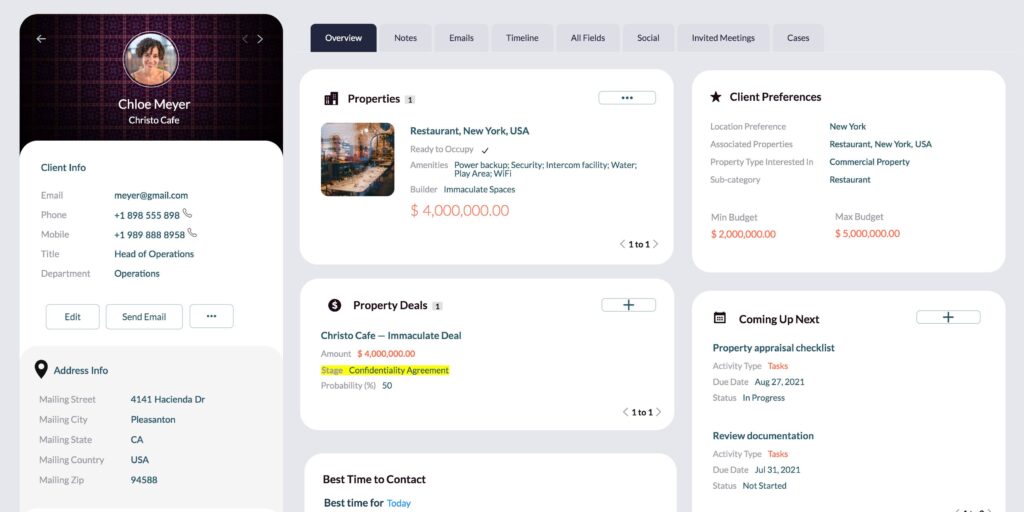
The Visibility Gap Between Developers and Brokers
Brokers operate at deal level. Developers operate at portfolio level.
Without shared dashboards:
Brokers see leads but not project velocity.
Developers see aggregate reports but not real deal activity.
Misalignment grows.
Visibility gaps create tension, speculation, and reactive management.
Role-Based Dashboards in Zoho CRM
Zoho CRM allows role-based visibility tailored to function.
Broker View
Assigned leads
Available units
Reservation status
Follow-up tasks
Developer / Management View
Sales per project
Unit movement rates
Revenue forecasting
Broker performance metrics
This structured visibility reduces noise and increases accountability.
Why Visibility Reduces Internal Conflict
When everyone sees the same data, conflict decreases.
Brokers understand performance expectations. Developers see operational reality. Forecasts become grounded in structured activity.
The best CRM for real estate aligns all stakeholders around a shared commercial truth.
WhatsApp + Zoho CRM: The Real Estate Communication Layer

Why WhatsApp Is Non-Negotiable in Real Estate
In Egypt and across MENA, real estate negotiation lives on WhatsApp.
Buyers expect instant responses. Voice notes replace emails. Documents are shared in chat threads. Decisions are influenced in conversational flow.
Ignoring WhatsApp is not realistic. Integrating it is essential.
The Risk of WhatsApp Outside CRM
When WhatsApp operates outside the CRM:
Conversations are lost.
Managers lack visibility.
Follow-ups are inconsistent.
If a broker leaves, deal history disappears.
Communication discipline collapses.
Integrating WhatsApp with Zoho CRM
Zoho CRM supports structured communication logging.
Conversations can be linked to leads and deals.
Interaction history is preserved.
Follow-up reminders can be triggered.
Managers gain visibility without invading broker autonomy.
Communication becomes structured, searchable, and accountable.
The best CRM for real estate must integrate with how clients actually communicate—not force unrealistic behavior change.
Zoho CRM vs Generic CRMs: Why Real Estate Needs Industry-Specific Structure
What Generic CRMs Typically Offer
Most CRMs provide:
Contact management
Deal tracking
Basic pipeline stages
Email logging
For many industries, that is sufficient.
For real estate, it is not.
What Real Estate Actually Requires
Real estate requires:
Live unit inventory
Reservation control
Payment plan flexibility
Broker-based distribution logic
WhatsApp integration
Project-level reporting
Developer dashboards
Without these, a CRM becomes a superficial tracking tool.
Why Zoho CRM Can Be Configured for Real Estate
Zoho CRM is not limited to a predefined template. It can be structured around real estate logic.
Units become structured objects.
Reservation workflows become enforceable.
Payment plans become linked to deals.
Dashboards reflect project-level movement.
This configurability is what positions it as the best CRM for real estate developers and broker teams who require both flexibility and control.
Connecting Everything: What the Best CRM for Real Estate Actually Looks Like
The best CRM for real estate integrates:
Lead capture
Automated broker distribution
Real-time unit tracking
Reservation logic
Payment plan management
WhatsApp communication
Broker dashboards
Developer reporting
When these components operate separately, friction multiplies. When they operate inside one structured CRM, predictability increases.
A well-implemented Zoho CRM real estate system connects marketing, sales, finance, and management in one commercial framework.
This is not about features. It is about operational cohesion.
FAQs
Q1: What is the best CRM for real estate developers?
The best CRM for real estate developers is one that manages unit inventory, reservations, payment plans, broker coordination, and dashboards in one system. Zoho CRM can be configured to support all these requirements.
Q2: Can Zoho CRM track unit availability?
Yes. Zoho CRM can structure units as records with real-time availability statuses and reservation logic.
Q3: Does Zoho CRM support payment plans?
Yes. Payment structures can be linked to units and deals for structured negotiation and visibility.
Q4: Is WhatsApp integration possible in Zoho CRM?
Yes. Conversations can be logged and linked to leads and deals for accountability.
Q5: How do dashboards differ for brokers and developers?
Zoho CRM supports role-based dashboards so brokers see deal-level data while developers see project-level insights.
Q6: Why are generic CRMs not enough for real estate?
Generic CRMs lack structured inventory, reservation logic, and payment plan integration required for real estate sales execution.
Conclusion
Real estate sales complexity demands structure.
Generic CRMs track contacts.
The best CRM for real estate controls operations.
Inventory must be real time.
Reservations must be enforceable.
Payment plans must be visible.
Brokers must be accountable.
Developers must have clarity.
When implemented strategically, Zoho CRM real estate configurations provide exactly that balance of control and flexibility.
If your current CRM tracks leads but does not control execution, it may be time to rethink what the best CRM for real estate truly means.
Ready to Implement the Best CRM for Real Estate?

If your team is still managing inventory in spreadsheets and negotiations in WhatsApp without structure, opportunities are slipping away.
Zoho CRM helps real estate developers and broker teams unify inventory, reservations, payment plans, and communication in one connected system.
👉 Talk to a Zoho CRM expert and see how the best CRM for real estate should actually work.