B2B sales are rarely quick wins. They involve long conversations, multiple decision-makers, internal approvals, price negotiations, and extended follow-ups that can stretch over months. Yet many B2B companies still rely on disconnected tools, spreadsheets, and inboxes to manage deals worth millions.
The result is familiar: stalled opportunities, unclear pipelines, inaccurate forecasts, and sales teams operating on intuition instead of structure.
This is where Zoho CRM for B2B sales plays a different role.
Instead of acting as a simple contact database, Zoho CRM—when designed properly—becomes a system that structures complexity. It helps B2B sales teams manage long sales cycles, enforce process discipline, preserve deal context, and give leadership a clear, real-time view of revenue.
This guide explains how Zoho CRM supports B2B sales teams, why traditional CRMs fail in long sales cycles, and how B2B companies can use Zoho CRM to build a predictable, scalable sales operation.
What Is Zoho CRM for B2B Sales?
Zoho CRM is a flexible customer relationship management platform designed to adapt to different business models. In B2B environments, that flexibility is not optional—it is essential.
Unlike transactional sales, B2B deals involve:
- Multiple stakeholders within the same account
- Long qualification and approval cycles
- High deal values and low tolerance for error
- Heavy reliance on relationships and follow-ups
Zoho CRM for B2B sales is not about tracking contacts. It is about managing accounts, opportunities, decision processes, and sales discipline across extended timelines.
When configured for B2B, Zoho CRM supports:
- Multiple contacts linked to a single account
- Custom pipelines per product, service, or region
- Approval flows and internal checkpoints
- Full visibility into every interaction over time
This makes Zoho CRM suitable for:
- B2B service providers
- SaaS and technology companies
- Industrial and solution-based businesses
- Enterprises with complex sales structures
Who This Guide Is For
This guide is designed for the people who feel the pain of unstructured B2B sales most clearly.
CEOs and Founders
Who need:
- Reliable forecasts
- Visibility without micromanagement
- Confidence in pipeline numbers
- Reduced dependency on individuals

Sales Directors and Heads of Sales
Who need:
- Consistent sales processes
- Clear deal ownership
- Accurate pipeline stages
- Better coaching insights
Pre-Sales and Sales Operations
Who need:
- Structured quotation and approval flows
- Reduced email back-and-forth
- Clear handoffs between teams
Sales Executives

Who need:
- Clear next steps
- Automated follow-ups
- Full context for every deal
- Less manual reporting
Zoho CRM delivers value differently to each role, while keeping everyone aligned within one system.
Why B2B Deals Stall (And Why CRMs Usually Don’t Fix It)
In most B2B organizations, deals rarely fail because the customer says “no.” They stall because the sales process loses momentum.
Common reasons include:
- Opportunities stuck in the same stage for weeks or months
- No enforced criteria to move deals forward
- Follow-ups depending on individual memory
- Conversations scattered across email, WhatsApp, and meetings
- Sales managers relying on verbal updates instead of data
Traditional CRMs often fail here because they focus on recording outcomes, not controlling process. They show what happened—but not why deals are stuck or what should happen next.
Zoho CRM addresses this by embedding structure into the sales process itself, making progress visible and measurable.
Core Capabilities of Zoho CRM for B2B Sales
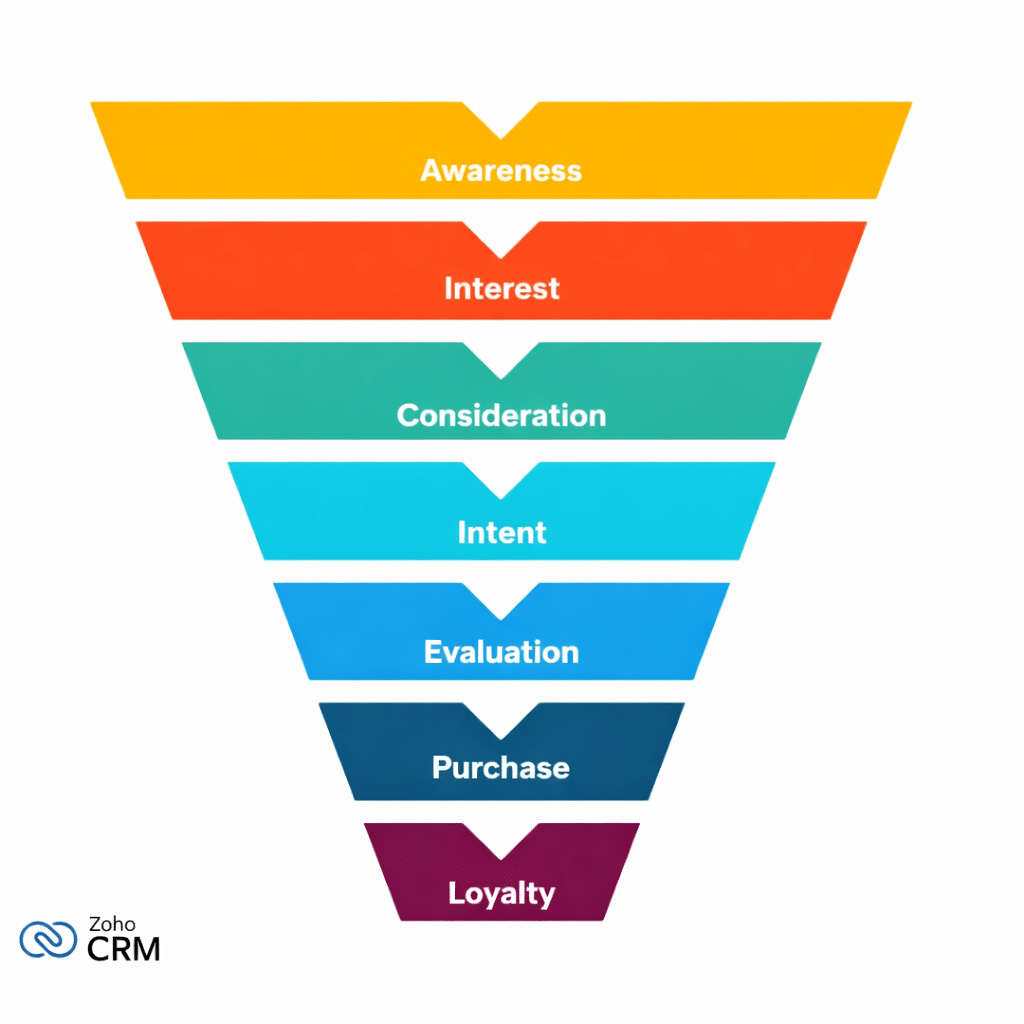
To understand how Zoho CRM supports B2B sales, it’s better to look at capabilities, not feature lists. These capabilities directly address the challenges of long, complex sales cycles.
1. Structured Sales Pipelines and Blueprints
B2B sales cannot rely on informal pipelines. Every stage must mean something.
Zoho CRM allows companies to:
- Design custom pipelines based on their sales model
- Define clear stages with entry and exit criteria
- Use Blueprints to enforce mandatory steps
- Require approvals before deals move forward
For example, a deal cannot move from “Proposal Sent” to “Negotiation” unless pricing is approved or required documents are attached.
This structure does not slow sales—it protects them. Sales teams know exactly what is expected, managers can identify bottlenecks early, and forecasting becomes far more reliable.
Zoho CRM replaces “best effort selling” with a repeatable, controlled process.
2. Managing Long Sales Cycles and Multi-Stakeholder Deals
In B2B sales, a deal rarely belongs to one contact. There are influencers, technical evaluators, financial approvers, and final decision-makers—often changing over time.
Zoho CRM supports this reality by enabling:
- Multiple contacts linked to a single account
- Role tagging (decision-maker, influencer, user)
- Full interaction history across months
- Timeline views that preserve deal context
Even if a sales executive changes, the deal does not reset. Every email, meeting, note, and approval remains visible.
This continuity is essential in long sales cycles, where losing context can mean losing the deal entirely.
3. Communication, Automation, and Follow-Up Discipline

One of the biggest risks in B2B sales is inconsistent follow-up. Not because teams don’t care—but because manual follow-up does not scale.
Zoho CRM introduces discipline through:
- Automated task creation based on deal stage
- Email integration that logs communication automatically
- Internal notifications for stalled deals
- Activity tracking that highlights inactivity
Sales executives no longer rely on memory to follow up. Managers no longer need to chase updates. The system itself supports consistency.
In effect, Zoho CRM becomes a sales assistant—handling reminders, logging communication, and keeping deals moving forward.
4. Sales Intelligence, Reporting, and Forecasting

Leadership decisions in B2B organizations depend on accurate forecasts. Unfortunately, many forecasts are built on assumptions rather than data.
Zoho CRM improves this by providing:
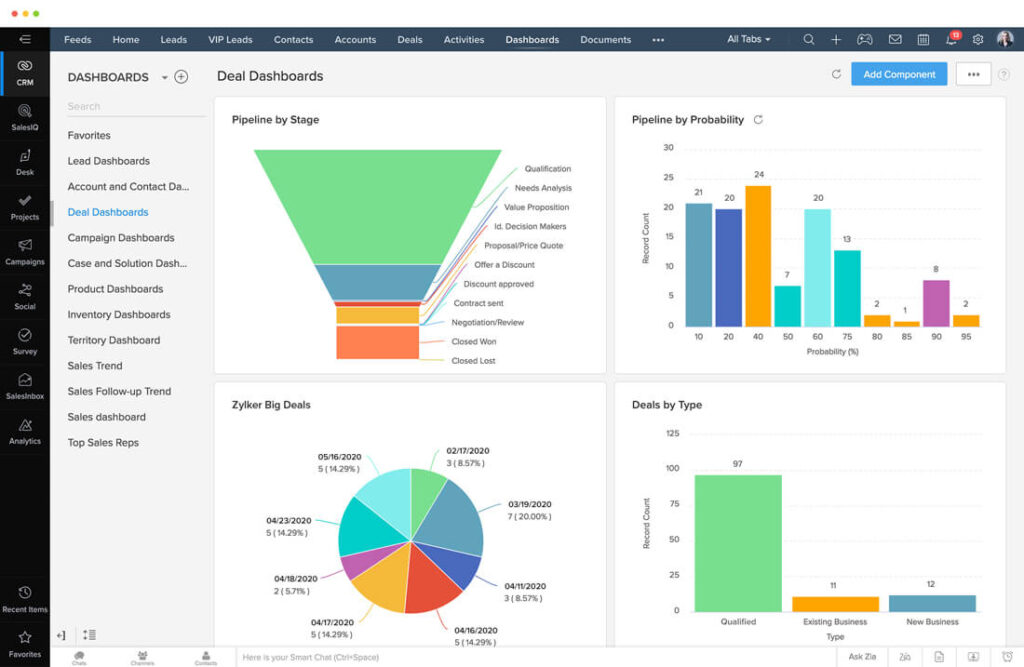
- Real-time pipeline dashboards
- Deal aging reports
- Activity-based performance metrics
- Forecasts based on actual deal progress
Instead of asking, “How confident are you about this deal?” leadership can see objective indicators: stage duration, activity levels, approval status, and historical conversion rates.
This shifts forecasting from intuition to evidence.
Using Zoho CRM for B2B Sales in the Egyptian Market
B2B sales in Egypt are deeply relationship-driven. Deals depend on trust, long conversations, and frequent informal communication—often through WhatsApp in addition to email.
A B2B CRM software in Egypt must accommodate this reality, not fight it.
Zoho CRM supports this by:
- Integrating email and WhatsApp-based communication
- Logging conversations for continuity
- Supporting Arabic and English users
- Adapting workflows to local sales culture
Rather than forcing rigid processes, Zoho CRM provides structure while allowing flexibility—an essential balance in the Egyptian B2B market.
Zoho CRM vs Traditional CRM Tools for B2B Teams
Many B2B companies adopt CRMs expecting immediate results, only to abandon them months later. The issue is rarely the tool—it’s the approach.
Traditional CRM usage often:
- Focuses on reporting after the fact
- Treats CRM as a management dashboard only
- Leaves process enforcement to individuals
Zoho CRM, when used correctly, focuses on:
- Process before reporting
- Structure before scale
- Visibility before assumptions
For B2B sales teams managing long cycles and complex deals, this difference directly impacts adoption, accuracy, and revenue predictability.
Common Mistakes When Using CRM in B2B Sales

Even the best CRM can fail if implemented poorly. Common mistakes include:
- Treating CRM as a reporting tool instead of a sales system
- Allowing deals to move stages without criteria
- Over-customizing without clear objectives
- Ignoring adoption and training
Successful B2B CRM implementations start with sales process design, align the system with real workflows, and prioritize user adoption from day one.
FAQs: Zoho CRM for B2B Sales
Is Zoho CRM suitable for B2B companies in Egypt?
Yes. Zoho CRM is widely used by B2B companies in Egypt and can be configured to support local sales workflows, communication styles, and reporting needs.
Can Zoho CRM manage long and complex sales cycles?
Yes. Zoho CRM is designed to track deals over extended periods, preserve full context, and enforce structured progression through sales stages.
Does Zoho CRM support multiple decision-makers in one deal?
Yes. Multiple contacts can be linked to a single account and deal, allowing teams to manage complex buying groups effectively.
Can Zoho CRM improve sales forecasting accuracy?
Yes. By combining deal stages, activity tracking, and historical data, Zoho CRM enables more accurate and evidence-based forecasts.
How customizable is Zoho CRM for B2B workflows?
Zoho CRM is highly customizable, allowing companies to tailor pipelines, automation, approvals, and dashboards to their specific sales processes.
Do B2B companies need a Zoho CRM implementation partner?
While Zoho CRM can be configured internally, working with an experienced partner helps ensure the system reflects real sales processes and supports long-term adoption.
Turning B2B Sales into a Predictable System

B2B sales will always involve complexity. What determines success is not how talented individual salespeople are, but how well the organization supports them with structure and visibility.
With the right implementation, Zoho CRM for B2B sales transforms scattered efforts into a controlled, measurable operation. Deals move forward with clarity, follow-ups happen on time, and leadership finally gains confidence in the numbers they see.
For B2B companies managing long sales cycles, Zoho CRM is not just a tool—it is the foundation for predictable growth and scalable revenue.
If your sales pipeline feels uncertain or dependent on individual effort, the system behind your sales may be the missing piece.
Ready to Bring Structure to Your B2B Sales Process?
If your B2B sales team is dealing with stalled deals, unclear pipelines, or forecasts that depend more on gut feeling than data, Zoho CRM can help you regain control.
At PyramidBITS, we implement Zoho CRM specifically for B2B sales teams — aligning the system with long sales cycles, multi-stakeholder deals, and real-world sales workflows.
👉 Talk to our team to see how Zoho CRM can be structured around your sales process, pipeline stages, and revenue goals.