
Introduction: Deals Don’t Die — They Get Stuck
In B2B sales, deals rarely end with a clear “no.”
They don’t collapse overnight or disappear dramatically. Instead, they slow down, pause, and quietly drift out of sight.
A proposal is sent, but no feedback comes back.
A demo goes well, but the next step never happens.
A decision-maker asks for time, then goes silent.
Most sales teams interpret this as a people problem. They assume the client lost interest, the salesperson didn’t push hard enough, or the timing simply wasn’t right. In reality, stalled deals are almost always a system failure, not a sales failure.
B2B sales cycles are long by nature. They involve multiple stakeholders, internal approvals, budget cycles, and shifting priorities. In this environment, even small process gaps—missed follow-ups, unclear stages, or lost context—can freeze momentum completely.
Without structure, strong sales teams still lose control. Talent alone cannot manage complexity at scale.
This is why modern B2B sales requires more than persuasion skills. It requires visibility, discipline, and control, exactly what a proper CRM for long sales cycles is designed to provide.
Reason #1: No Clear Sales Stages or Exit Criteria
One of the most common causes of stalled B2B deals is the absence of clearly defined sales stages. Many teams use labels like “Qualified,” “Proposal Sent,” or “Negotiation,” but those labels often mean different things to different salespeople.
A deal moves forward based on gut feeling rather than objective progress. “Proposal sent” becomes a dead zone where deals sit for weeks with no clear next action. No one knows whether the deal is advancing, blocked, or effectively lost.
This lack of structure makes forecasting meaningless. Pipelines appear full, but leadership has no reliable way to assess deal quality or velocity. Optimism replaces data, and surprises become inevitable.
How Zoho CRM Restores Control
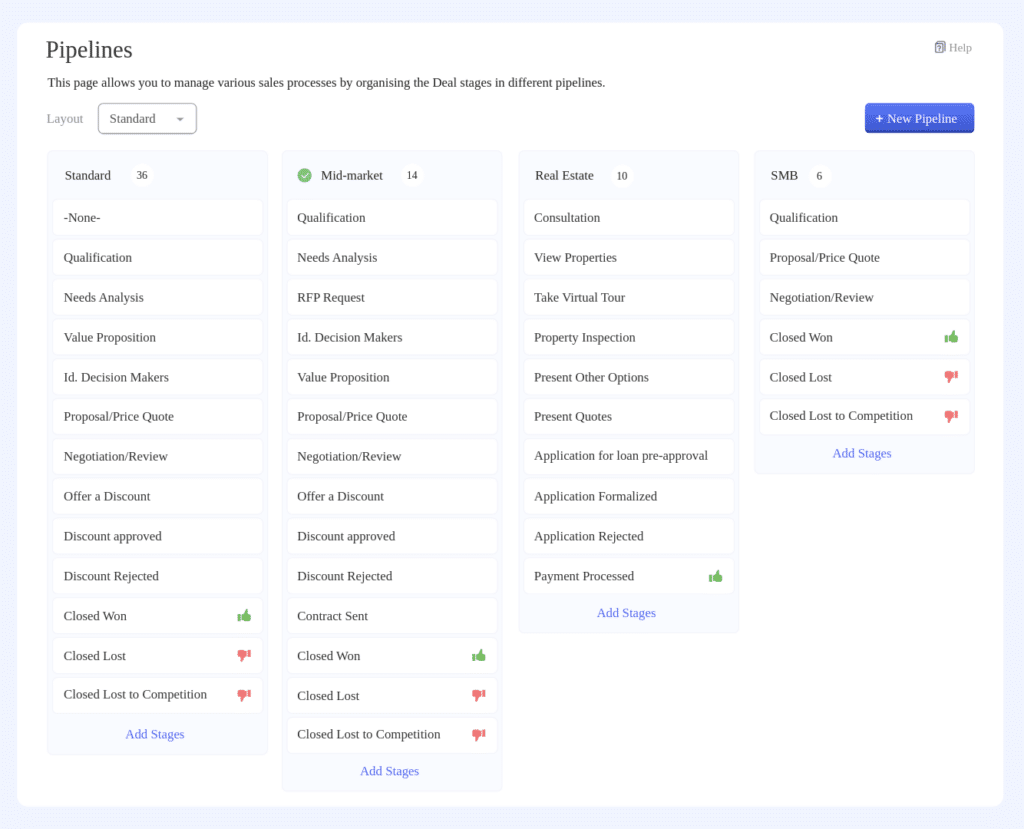
Zoho CRM introduces structured pipelines with clear entry and exit criteria for each stage. Deals don’t move forward unless specific actions are completed. This turns the sales process into a controlled flow rather than a subjective judgment.
With Sales Blueprints, Zoho CRM enforces process discipline. It guides sales reps step by step, ensuring that progress is real, not assumed. Deals either move forward with momentum or are flagged early as stalled.
Reason #2: Follow-Ups Depend on Memory, Not a System
In long B2B sales cycles, follow-ups are everything. Momentum is fragile, and silence creates doubt. Yet many sales teams still rely on memory, personal calendars, or manual reminders to manage follow-ups.
A rep plans to check in “next week,” but gets busy. A reminder is missed. The client assumes the deal is no longer a priority. Slowly, interest fades.
In short sales cycles, this might be recoverable. In CRM for long sales cycles, silence is often fatal.
How Zoho CRM Restores Control
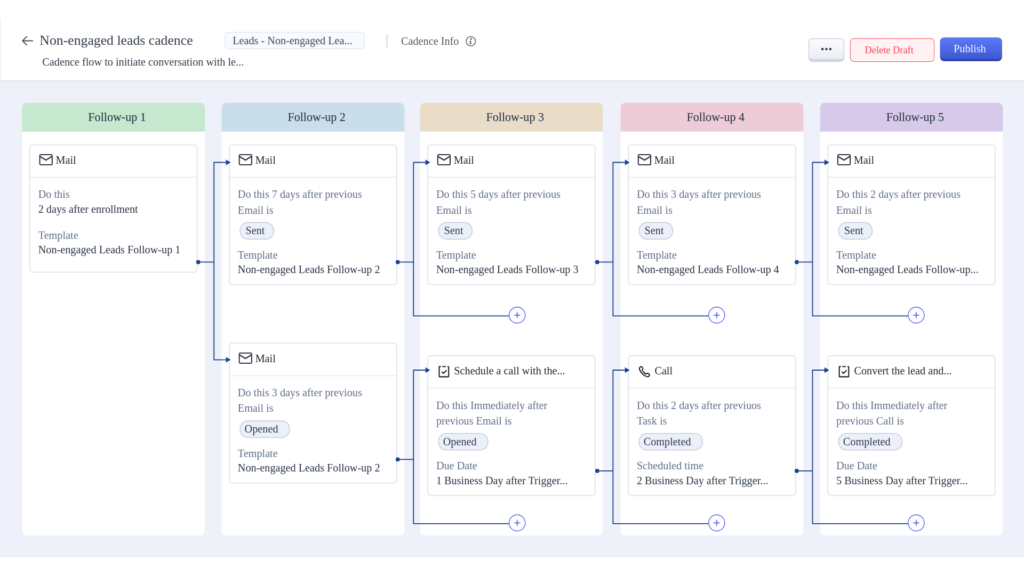
Zoho CRM replaces memory with automation. Follow-up tasks are created automatically based on deal stage, time elapsed, or activity history. Deal aging alerts highlight opportunities that are slowing down before they become unrecoverable.
Instead of asking sales reps to “remember,” the system ensures consistency. Every deal follows a defined cadence, protecting momentum throughout the cycle.
Reason #3: Multiple Stakeholders, No Central Deal Context
B2B deals rarely involve a single decision-maker. Technical evaluators, finance teams, procurement, managers, and executives all play a role—and those roles often change over time.
When deal context lives in scattered emails, personal notes, or individual inboxes, continuity breaks down. If a sales rep changes roles or leaves, the deal effectively resets. New reps lack history, context, and credibility.
Clients are forced to repeat themselves, which erodes trust and slows decisions.
How Zoho CRM Restores Control
Zoho CRM treats deals as account-based, not contact-based. Each deal can include multiple stakeholders, decision-makers, and influencers, all tied to a single opportunity.
Every interaction—emails, calls, meetings, notes—is logged in one place. Context becomes institutional, not personal. Deals continue smoothly even when team members change.
This centralized view is essential for maintaining momentum in complex B2B sales environments.
Reason #4: Internal Approvals Slow Everything Down
Many stalled deals are not blocked by the client, but by internal friction. Pricing approvals happen over email. Finance reviews take days. Management feedback arrives late. Sales teams wait without visibility into what’s causing the delay.
From the client’s perspective, this looks like hesitation or disorganization. Confidence drops, and urgency disappears.
How Zoho CRM Restores Control

Zoho CRM introduces approval workflows directly into the deal process. Pricing, discounts, and special terms move through predefined approval paths with full visibility.
Sales teams know exactly where the deal is stuck and why. Managers see bottlenecks early. Internal delays stop being invisible obstacles and start becoming manageable steps.
Reason #5: Sales and Pre-Sales Are Not Aligned
In many B2B organizations, sales and pre-sales operate in parallel rather than together. Handoffs are unclear. Required inputs are missing. Proposals and demos are delayed while teams chase information across emails and chats.
Every delay weakens deal momentum. Clients lose interest not because the solution is wrong, but because the process feels slow and fragmented.
How Zoho CRM Restores Control
Zoho CRM enables shared deal ownership across sales, pre-sales, and operations. Tasks are assigned clearly, dependencies are visible, and progress is tracked in real time.
Everyone works from the same deal record. Internal collaboration becomes part of the sales process, not an afterthought.
Reason #6: Managers Discover Problems Too Late
Many sales leaders only review pipelines at the end of the month. By then, stalled deals have already impacted revenue. Missed targets come as a surprise rather than a predictable outcome.
Without early warning signals, leadership is forced into reactive decision-making.
How Zoho CRM Restores Control
Zoho CRM provides real-time dashboards that show pipeline health, deal aging, and stage conversion rates. Managers see where deals slow down, which stages cause friction, and which reps need support.
Problems are addressed while deals are still recoverable, not after they’re lost.
Reason #7: CRM Used for Reporting, Not Control

In many organizations, CRM systems are treated as reporting tools. Data is updated after meetings, often inconsistently. There is no enforcement, no guidance, and no accountability.
The real sales process lives in people’s heads, not in the system.
How Zoho CRM Restores Control
Zoho CRM functions as a process engine, not just a database. Workflows, Blueprints, and automation enforce how deals move forward.
The system guides behavior instead of documenting it after the fact. Discipline becomes automatic, and control is built into daily sales activity.
From Stalled Deals to Sales Momentum
When Zoho CRM is implemented as a control system rather than a reporting tool, B2B sales teams experience a fundamental shift.
Deals move predictably.
Follow-ups happen on time.
Stakeholders stay aligned.
Managers see issues early.
Momentum replaces uncertainty.
To explore the full framework behind structured B2B selling, read:
Zoho CRM for B2B Sales: The Complete Guide to Managing Long Sales Cycles
FAQs: B2B Sales & Long Sales Cycles
Why do B2B sales deals stall?
Most B2B deals stall due to unclear stages, missed follow-ups, internal delays, and lack of visibility. Without structure, momentum fades even when interest remains.
How can CRM prevent stalled deals?
A CRM enforces follow-ups, tracks deal aging, centralizes context, and provides visibility—preventing silence and delays from killing momentum.
Is Zoho CRM suitable for long sales cycles?
Yes. Zoho CRM is designed to handle complex, multi-stakeholder, long-cycle B2B sales with structured pipelines and automation.
Can Zoho CRM manage multi-stakeholder deals?
Yes. It supports multiple contacts per deal, full interaction timelines, and account-based selling.
How does Zoho CRM improve follow-ups?
Through automated tasks, reminders, alerts, and SLA logic that ensures consistent engagement throughout the sales cycle.
Ready to Get B2B Deals Moving Again?

If your sales pipeline looks full but revenue isn’t moving, the issue may not be your team—it may be the lack of a structured system.
Zoho CRM helps B2B teams regain control over long sales cycles, enforce follow-ups, and move deals forward with clarity.
Talk to a Zoho CRM expert and see how stalled B2B deals turn into predictable revenue.
Book a Free Demo
Talk to a B2B CRM Expert