
Introduction
Social insurance Egypt rules look simple on paper: the employee pays 11%, the employer pays 18.75%. Yet every month, HR and payroll teams across the country get the number wrong. The rate is rarely the problem. The wage it is applied to is.
Add a new minimum and maximum every January, joiners and leavers in the middle of the month, and a payroll sheet that only one person understands, and small errors pile up fast.
This guide covers the 2026 figures, five steps to calculate contributions correctly, the six mistakes that cost Egyptian companies money, and how Zoho Payroll and Zoho People take the manual work out of it.
Social Insurance Egypt at a Glance: The 2026 Numbers
Social insurance in Egypt is governed by Law No. 148 of 2019 and run by the National Organization for Social Insurance (NOSI). These are the figures a payroll team works with in 2026:
| Item | 2026 figure |
|---|---|
| Employee contribution | 11% of the insurable wage |
| Employer contribution | 18.75% of the insurable wage |
| Combined | 29.75% |
| Minimum insurable wage | EGP 2,700 per month |
| Maximum insurable wage | EGP 16,700 per month |
| Payment deadline | By the 15th of the following month |
| New hire registration | Within 15 days of the start date |
The wage limits rose on 1 January 2026, from EGP 2,300 and EGP 14,500 in 2025, as Mercans reported. They increase by 15% a year until 2027, so the same update is coming again next January.
Rates and penalties are summarised in Mondaq’s overview of the law. This article is a practical guide, not legal or tax advice, so confirm the details for your company with your accountant.

How to Calculate Social Insurance in 5 Steps
Step 1: Work Out the Insurable Wage
Contributions are not calculated on whatever lands in the employee’s bank account. They are calculated on the insurable wage: basic salary plus the insurable parts of pay, such as bonuses, incentives, commissions and certain allowances. Some payments are excluded by regulation.
Therefore the first job is to label every pay component as insurable or not. This one decision drives every number that follows.
Step 2: Apply the Minimum and Maximum
Next, compare the insurable wage with the two limits. If it is below EGP 2,700, you calculate on EGP 2,700. If it is above EGP 16,700, you calculate on EGP 16,700. Anything in between is used as it is.
Step 3: Calculate the Employee and Employer Shares
Multiply the capped wage by 11% for the employee share, which is deducted from the salary. Then multiply it by 18.75% for the employer share, which the company pays on top.
Here is how the social insurance Egypt calculation works for three employees:
| Insurable wage | Wage used | Employee 11% | Employer 18.75% | Total paid to NOSI |
|---|---|---|---|---|
| EGP 2,000 | EGP 2,700 (minimum) | EGP 297.00 | EGP 506.25 | EGP 803.25 |
| EGP 10,000 | EGP 10,000 | EGP 1,100.00 | EGP 1,875.00 | EGP 2,975.00 |
| EGP 25,000 | EGP 16,700 (maximum) | EGP 1,837.00 | EGP 3,131.25 | EGP 4,968.25 |
Notice the third row. Without the cap, the company would calculate on EGP 25,000 and pay EGP 7,437.50, almost EGP 2,500 too much for one employee in one month.

Step 4: Handle Joiners, Leavers and Salary Changes
Real payroll is never a fixed list. Each month, someone joins, someone resigns and someone gets a raise. New employees must be registered with NOSI within 15 days, and leavers must be removed so the company stops paying for them.
In addition, a raise or a new commission scheme changes the insurable wage, so the contribution changes with it.
Step 5: Pay and Reconcile Before the 15th
Finally, add up both shares for every employee and pay NOSI by the 15th of the following month. Then check that the total matches three things: the payroll register, the payslips and the accounting entry. If the three disagree, find out why before the payment goes out, not after an inspection.
6 Costly Mistakes With Social Insurance Egypt Payroll Teams Make
Most errors come from the process, not from bad intent. These six appear again and again in companies that run payroll in Excel.
1. Using last year’s limits. The sheet still says EGP 14,500 in February. As a result, every higher-paid employee is under-contributed, and the gap grows each month until someone notices.
2. Calculating on gross or net instead of the insurable wage. This either overpays every month or leaves a shortfall that surfaces during an inspection.
3. Ignoring the cap. As the example shows, forgetting the maximum means the company quietly overpays for its senior staff.
4. Registering new hires late. Missing the 15-day window exposes the company to fines. Under the law, non-registration or incorrect registration carries penalties of EGP 20,000 to EGP 100,000.
5. Paying for people who have left. When HR and payroll keep separate lists, a leaver can stay on the contribution file for months.
6. One person, one sheet. If the only employee who understands the formulas is on leave, payroll stops. If that person resigns, the knowledge goes too.
Beyond the money, there is the human cost. An employee who finds a wrong deduction on a payslip stops trusting payroll, and every later question takes longer to settle. These are the same warning signs listed in our guide to the signs your team needs HR management software.
How Zoho Payroll and Zoho People Automate the Calculation
The fix is not a better spreadsheet. It is one system where employee data and payroll share the same record. That is what the Zoho HR Suite provides, with Zoho People holding the employee data and Zoho Payroll, configured for Egyptian rules, running the numbers.
- One employee record. A joiner added in Zoho People flows into payroll, and a leaver is removed from it. Consequently, nobody is paid for after they have gone. See how the two connect in our post on Zoho People integration with Zoho Payroll.
- Pay components tagged once. Each component is marked insurable or not during setup, so the insurable wage is built the same way every month.
- Limits and rates held in one place. When the minimum and maximum change in January, they are updated once and apply to every employee, instead of being edited cell by cell.
- Both shares calculated automatically. The 11% deduction and the 18.75% employer cost are worked out on the capped wage for each employee, alongside income tax and absence deductions.
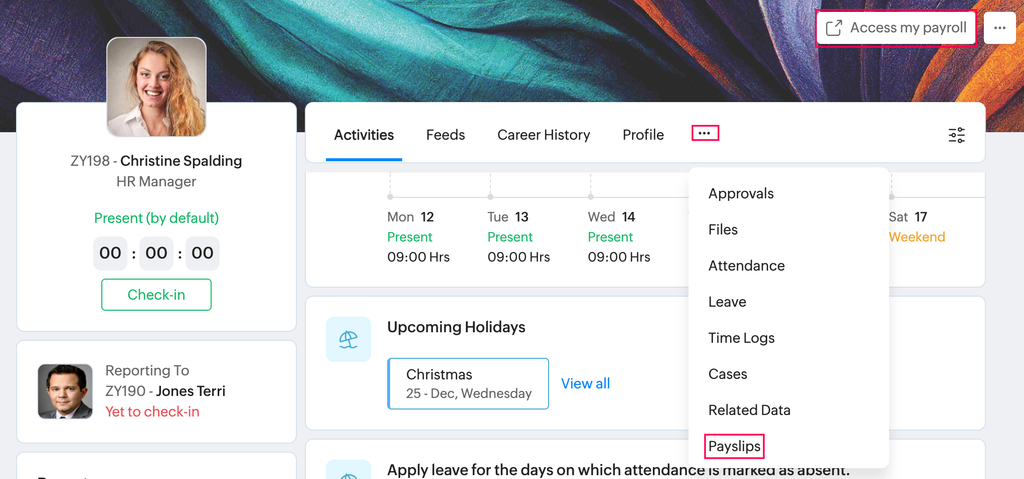
- Payslips employees can read. Each payslip shows the social insurance deduction clearly, in Arabic or English, which cuts the “why is my salary different?” questions.
- Reports ready for payment and audit. A monthly contribution report gives finance the figure to pay and a record to show an inspector.
In practice, this turns the social insurance Egypt run from a few stressful days into a review step. For the wider picture, read our guides to HR and payroll software for Egypt and how Zoho Payroll supports compliance in Egypt.
A Month-End Social Insurance Checklist
Whether you use a system or a sheet, run through these checks before each payment:
- Are all new hires from this month registered with NOSI?
- Have all leavers been removed?
- Do the wage limits in your calculation match the current year?
- Have raises, bonuses and commissions updated the insurable wage?
- Does the total match the payroll register, the payslips and the accounting entry?
- Is the payment scheduled before the 15th?
If any answer takes more than a few minutes to find, that is a sign the process depends too much on manual work. Attendance and leave data feed the same payroll, which is why attendance and payroll in one system removes a second source of errors.
Social Insurance Egypt: FAQs
What is the social insurance rate in Egypt in 2026?
The employee pays 11% and the employer pays 18.75% of the insurable wage, for a combined 29.75%.
What are the minimum and maximum insurable wages in 2026?
EGP 2,700 and EGP 16,700 per month, effective 1 January 2026. Both rise by 15% a year until 2027.
When must contributions be paid?
By the 15th of the month after the payroll month, according to Playroll’s Egypt payroll guide. Late payment adds extra charges.
Is social insurance calculated on gross salary?
No. It is calculated on the insurable wage, which is basic salary plus the insurable parts of pay, and it is limited by the yearly minimum and maximum.
Can social insurance Egypt calculations be fully automated?
Yes. Once pay components, rates and limits are set up in Zoho Payroll, both shares are calculated for every employee each month. A person should still review the totals before payment.
Get Social Insurance Right Every Month
Social insurance Egypt compliance comes down to three things: the right wage, the right limits and an up-to-date employee list. Excel can do the arithmetic, but it cannot keep those three in sync on its own. A connected HR and payroll system can.
Book a FREE Demo with PyramidBITS and see the calculation run on data that looks like yours. You can also read our complete guide to Zoho HR in Egypt.