Introduction
Zoho HR Suite helps businesses eliminate one of the most common operational problems in HR: managing employee information across multiple disconnected systems. As companies grow, attendance records, leave balances, payroll calculations, employee profiles, and recruitment data often end up spread across spreadsheets, payroll software, biometric systems, and shared documents. While each tool may work individually, together they create unnecessary complexity that slows HR operations and increases the risk of costly mistakes.
For small businesses, this fragmented approach may seem manageable. HR teams manually transfer attendance data into payroll spreadsheets, update employee information in several places, and reconcile discrepancies before every payroll cycle. However, as the workforce grows, these manual processes become increasingly difficult to sustain.
The issue is not simply administrative workload. Every disconnected system introduces another opportunity for inconsistent employee data, delayed payroll processing, duplicate entries, and reporting inaccuracies. HR professionals spend valuable time verifying information instead of focusing on strategic initiatives such as employee development, workforce planning, and improving the employee experience.
This is where Zoho HR Suite creates significant value. By bringing attendance, leave management, employee records, recruitment, and payroll into one connected platform, businesses create a single source of truth for HR data. Instead of moving information manually between systems, employee records flow seamlessly across HR processes, improving accuracy, visibility, and operational efficiency.
Why HR Data Becomes Fragmented as Companies Grow
Almost every growing company experiences the same challenge.
As the business expands, HR requirements become more specialized. Rather than investing in an integrated HR management system, companies often solve each new requirement independently.
For example:
- Attendance is managed using a biometric device.
- Leave requests are tracked in spreadsheets.
- Payroll calculations happen in Excel.
- Employee records are maintained in shared folders.
- Recruitment is handled through emails and job portals.
- Performance reviews are documented separately.
Initially, this approach appears practical because each department solves its immediate problem. Over time, however, these disconnected solutions create operational silos.
The same employee information must be entered multiple times across different systems. A salary adjustment requires updates in payroll records, employee files, and reporting documents. A department transfer must be reflected everywhere manually. Even simple changes, such as updating an employee’s job title, become repetitive administrative tasks.
As the organization grows, HR teams spend more time maintaining data consistency than managing people.
Fragmented HR data also affects collaboration between departments. Finance relies on HR for payroll information. Managers depend on HR for attendance reports. Leadership expects workforce insights for decision-making. When information is spread across multiple systems, producing accurate reports becomes time-consuming and error-prone.
This is why growing businesses increasingly move toward integrated HR platforms rather than adding more standalone tools.
The Hidden Cost of Managing Attendance and Payroll Separately

Attendance and payroll are two of the most closely connected HR functions, yet many organizations continue managing them independently.
Every payroll cycle begins with attendance data.
Working hours, overtime, absences, late arrivals, approved leave, unpaid leave, holidays, and shift schedules all influence salary calculations. When attendance information lives outside the payroll system, HR teams must manually reconcile these records before salaries can be processed.
This creates several operational challenges.
Manual Data Transfers
Many HR departments still export attendance reports from biometric systems before importing or re-entering the information into payroll spreadsheets.
Each transfer introduces the possibility of:
- Missing attendance records
- Incorrect overtime calculations
- Duplicate entries
- Manual typing errors
Even small mistakes can affect employee salaries and require additional time to investigate and correct.
Longer Payroll Processing Times
Disconnected systems increase the amount of preparation required before payroll can be finalized.
Instead of reviewing payroll calculations, HR professionals spend hours validating attendance records, checking leave balances, and confirming deductions.
As the workforce grows, these manual reconciliation processes become increasingly difficult to manage within payroll deadlines.
Reduced Reporting Accuracy
When attendance and payroll operate independently, reporting becomes fragmented.
Managers may receive attendance reports from one system while payroll costs are generated from another. Leadership must manually combine these reports to understand workforce productivity and labor costs.
This delay reduces visibility and limits the organization’s ability to make informed operational decisions.
Managing attendance and payroll as separate processes may appear manageable, but in reality, it creates hidden inefficiencies that affect both HR performance and employee satisfaction.
Why Attendance Data Should Flow Directly Into Payroll
Attendance is much more than a record of when employees arrive and leave work.
It forms the foundation of accurate payroll calculations.
Every attendance event can influence payroll outcomes, including:
- Overtime hours
- Late arrivals
- Early departures
- Approved leave
- Unpaid leave
- Shift differentials
- Public holidays
- Attendance-based incentives
When these records flow automatically into payroll, HR teams eliminate one of the largest sources of manual work.
Instead of comparing spreadsheets and validating exported reports, payroll calculations are based on live attendance data.
This provides several important advantages.
Improved Payroll Accuracy
Accurate attendance records lead to more reliable salary calculations.
Because payroll uses approved attendance data directly, the likelihood of manual calculation errors decreases significantly.
Employees gain confidence that salaries are calculated fairly and consistently.
Faster Payroll Processing
Payroll preparation becomes considerably more efficient when attendance information is already connected.
HR teams spend less time collecting data and more time reviewing payroll before processing.
This helps organizations meet payroll deadlines with greater confidence.
Better Compliance
Many businesses must comply with labor regulations regarding working hours, overtime, leave entitlements, and payroll documentation.
Keeping attendance and payroll connected creates stronger audit trails and improves record accuracy, reducing compliance risks associated with manual processes.
How Zoho HR Suite Connects Employee Data in One System
One of the biggest strengths of Zoho HR Suite is that it treats employee information as a shared business asset rather than isolated records maintained by different departments.
Instead of creating separate employee profiles across multiple systems, Zoho HR Suite maintains a centralized employee record that supports every stage of the employee lifecycle.
For example:
- Recruitment begins in Zoho Recruit.
- Employee records are managed through Zoho People.
- Attendance, leave, and shift management remain connected.
- Payroll calculations are handled through Zoho Payroll using the same employee information.
Because all these applications work together, HR teams avoid duplicate data entry and maintain greater consistency across operations.
A new employee only needs to be added once.
When information changes, updates flow throughout the connected HR ecosystem rather than requiring manual updates in multiple systems.
This unified approach improves operational efficiency while giving HR professionals greater confidence in the accuracy of their data.
Eliminating Duplicate Data Entry Across HR Teams
Duplicate data entry is one of the most common causes of HR inefficiency.
Whenever employee information exists in multiple locations, every change creates additional administrative work.
Consider a simple promotion.
Updating one employee may require changing:
- Job title
- Department
- Manager
- Salary
- Payroll information
- Approval workflows
- Reporting structures
If these systems operate independently, every update becomes a manual task.
With Zoho HR Suite, employee information is maintained through one connected profile, significantly reducing repetitive administrative work.
This not only saves time but also improves data consistency across the organization.
HR professionals can focus on supporting employees rather than maintaining spreadsheets.
Better Visibility for HR Managers and Business Leaders
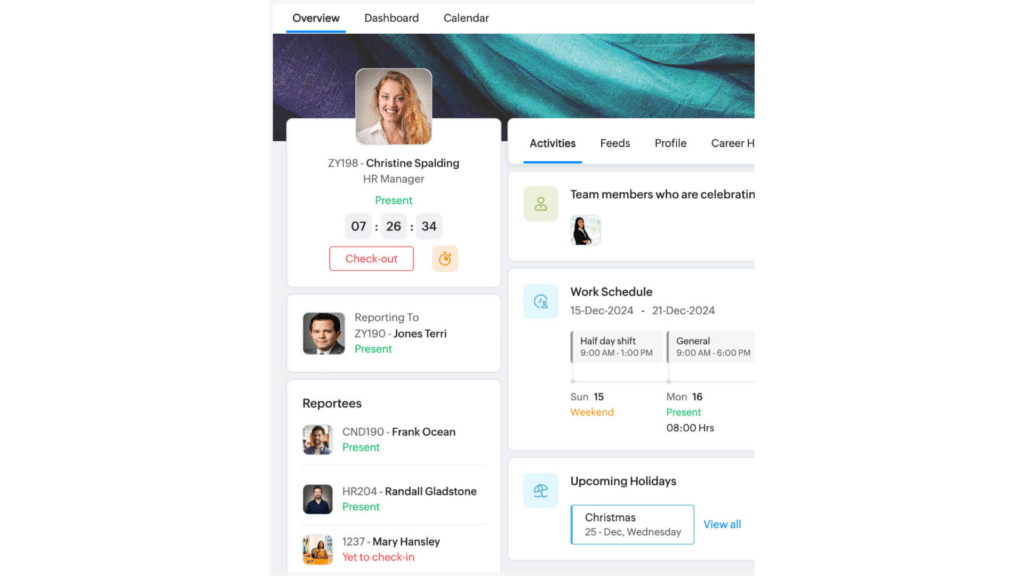
One of the biggest advantages of a connected HR system is improved visibility.
HR managers require detailed operational information to manage daily activities, while business leaders need broader workforce insights to support strategic decisions.
Zoho HR Suite provides role-based visibility that serves both groups.
HR Managers Can Monitor
- Employee attendance
- Leave balances
- Payroll preparation
- Recruitment progress
- Employee records
- Pending approvals
Business Leaders Can View
- Workforce growth
- Payroll costs
- Department headcount
- Attendance trends
- Leave utilization
- HR performance metrics
Instead of waiting for manually prepared reports, decision-makers gain access to timely information that supports better planning and resource allocation.
Why One Connected HR System Improves Employee Experience
Employees may never see the complexity behind HR operations, but they experience the results every day.
When HR systems are disconnected, employees often encounter:
- Delayed leave approvals
- Payroll errors
- Missing attendance records
- Slow responses to HR requests
- Conflicting employee information
These issues reduce trust in HR processes and create unnecessary frustration.
A connected HR system creates a more consistent employee experience by ensuring information remains accurate throughout every interaction.
Employees benefit from:
- Faster HR processes
- More accurate payroll
- Better visibility into attendance and leave balances
- Improved self-service capabilities
- Greater confidence in HR operations
Ultimately, efficient HR systems contribute to a more positive workplace experience while reducing administrative burdens for HR teams.
Common Signs Your HR Team Has Outgrown Spreadsheets

Many businesses continue using spreadsheets because they seem familiar and flexible. However, certain warning signs indicate it is time to adopt a dedicated HR management system.
Your organization may have outgrown spreadsheets if:
- Payroll preparation takes several days every month.
- Attendance data must be exported manually before payroll.
- Employee information exists in multiple files.
- HR and finance spend significant time reconciling data.
- Managers request reports that require manual preparation.
- Employee records become inconsistent across systems.
- HR teams spend more time maintaining data than supporting employees.
These challenges rarely improve as organizations continue growing. Instead, they become more difficult to manage without integrated systems.
Why Zoho HR Suite Is Built for Growing Businesses
Growing businesses need more than isolated HR software.
They need a connected platform capable of supporting recruitment, employee management, attendance, leave, payroll, reporting, and workforce planning without creating additional administrative complexity.
This is exactly where Zoho HR Suite delivers value.
Rather than forcing HR teams to manage multiple disconnected applications, Zoho HR Suite creates one integrated environment where employee information flows naturally across every HR process.
As organizations grow, this integrated approach provides:
- Greater operational efficiency
- Improved payroll accuracy
- Reduced manual work
- Better reporting
- Stronger compliance
- Enhanced employee experiences
Instead of spending time managing disconnected systems, HR professionals can focus on building stronger teams and supporting business growth.
FAQs About Zoho HR Suite, Attendance, and Payroll
Why should attendance and payroll be connected?
Attendance directly affects payroll calculations through overtime, leave, deductions, and working hours. Connecting both systems improves accuracy and reduces manual work.
Can Zoho HR Suite automate payroll calculations?
Yes. Zoho HR Suite connects attendance, employee records, and payroll to automate salary calculations and reduce manual processing.
How does Zoho People work with Zoho Payroll?
Zoho People manages employee records, attendance, and leave, while Zoho Payroll uses that information to process accurate payroll within one connected ecosystem.
Is Zoho HR Suite suitable for growing businesses?
Yes. Zoho HR Suite is designed to help growing businesses manage HR operations efficiently while scaling without relying on disconnected systems.
Can employees access their own attendance and leave information?
Yes. Employees can view attendance records, leave balances, and other HR information through self-service capabilities, improving transparency and reducing HR inquiries.
Ready to Bring Your HR Data Into One Connected System?
If your HR team is still moving employee information between attendance software, payroll spreadsheets, and separate HR systems, you’re spending valuable time on manual work that can be automated.
Zoho HR Suite connects attendance, employee records, leave management, recruitment, and payroll in one integrated platform, helping HR teams improve accuracy, streamline operations, and scale with confidence.
Talk to a Zoho HR expert and discover how PyramidBITS can simplify your HR operations.