Introduction
Ask a marketing manager why sales isn’t closing more deals, and you’ll usually hear: “the leads are fine, sales just isn’t following up fast enough.” Ask the sales director the same question, and you’ll hear the opposite: “the leads marketing sends us aren’t ready to buy.” Both are describing the same broken process from two different sides of it. This is what sales and marketing alignment actually solves — not a personality conflict, but a structural gap between two teams working from different definitions, different data, and different timelines.
It’s a widely recognized problem, not a rare one. HubSpot’s own State of Marketing research lists sales-and-marketing alignment among the top challenges marketers report year after year — yet very few companies actually name fixing it as a real priority. Knowing the problem exists and building a system to fix it are two different things, and most companies never get past the first one.
Why Marketing and Sales Keep Blaming Each Other
The blame loop between marketing and sales usually comes down to three structural gaps, not effort or talent:
- No shared definition of a “good” lead. Marketing counts a form-fill as a win. Sales counts a signed contract as a win. Nobody agreed on what happens in between.
- No shared visibility. Marketing can’t see what happens to a lead after handoff. Sales can’t see what a lead did before it arrived. Each team is flying blind on the other half of the process.
- No agreed speed standard. Marketing assumes sales will call quickly. Sales assumes marketing will tell them which leads matter. Neither assumption is written down anywhere.
None of this gets fixed by a pep talk or a stricter manager. It gets fixed by building a shared marketing to sales handoff process that both teams actually follow — which is what real sales and marketing alignment looks like in practice, not in theory.
What Sales and Marketing Alignment Actually Means
Sales and marketing alignment is not a vague cultural goal. In practical terms, for a company with real lead volume, it means four specific things are true at the same time: both teams agree on what a qualified lead looks like, both teams can see the same pipeline data, both teams have agreed on how fast a lead gets contacted, and information flows back from sales to marketing about which leads actually convert. When even one of these is missing, the other three tend to break down too.

A Practical Framework: 4 Pillars of a Working Handoff
This is the part most companies skip — not because it’s complicated, but because nobody owns building it. Here are the four pillars of working sales and marketing alignment, in the order they need to be set up.
Pillar 1 — Shared Lead Definitions
Marketing and sales need to agree, in writing, on what separates a Marketing Qualified Lead (MQL) from a Sales Qualified Lead (SQL). This doesn’t need to be complex — job title, company size, and a specific action (like requesting a demo) are usually enough. What matters is that both teams use the same definition, not two different ones.
Pillar 2 — Shared Visibility
Both teams need to see the same lead record, updated in real time — not a weekly export or a screenshot in a WhatsApp group. Marketing should be able to see what happened after handoff. Sales should be able to see the campaign, offer, and content that brought the lead in.
Pillar 3 — A Speed Standard
The gap between “lead captured” and “lead contacted” is where most of the damage happens. Independent research on this is consistent: a Harvard Business Review study of web-generated sales leads found that companies contacting a lead within the first hour qualify it at dramatically higher rates than companies that wait even a few hours longer. A working framework sets an actual number — five minutes, one hour, same business day — and builds the system to hit it automatically, rather than leaving it to whoever happens to check their inbox first.
Pillar 4 — A Feedback Loop
Sales needs to tell marketing which leads actually turned into real deals, not just which ones “felt” low quality. Without this loop, marketing keeps optimizing for lead volume instead of lead quality, and the same argument repeats every quarter.

How Zoho CRM Makes This Framework Operational
A framework only works if the system enforces it automatically — otherwise it’s a policy document nobody follows after the second week. This is where Zoho CRM turns the four pillars into daily practice rather than good intentions.
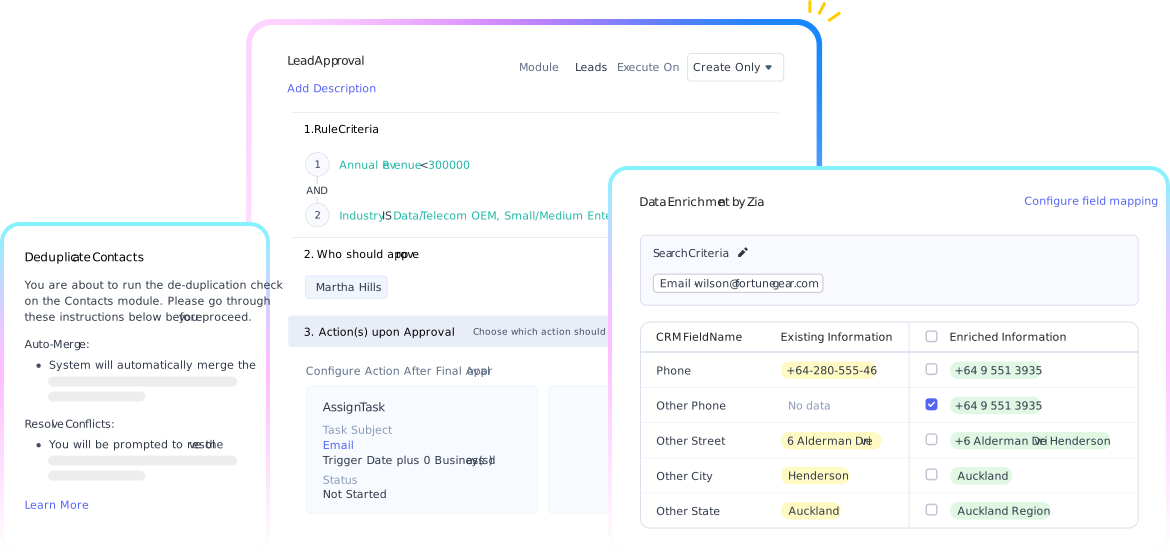
Shared lead definitions become CRM fields and scoring rules. MQL and SQL criteria are configured directly into Zoho CRM, and Zia AI scores incoming leads against them automatically, so there’s no argument about whether a lead is “ready” — the system already flagged it.
Shared visibility becomes one dashboard both teams open. Instead of a spreadsheet passed back and forth, marketing and sales look at the same live pipeline in Zoho CRM — the same view our guide to fixing why B2B deals stall covers in more depth for longer sales cycles specifically.
Speed standards become assignment rules, not reminders. The moment a lead crosses the SQL threshold, Zoho CRM assigns it instantly to the right rep — no manual sorting, no daily list review. For companies with more complex, multi-stage processes, Zoho CRM Blueprints can enforce the speed standard as a hard rule the deal can’t skip.
The feedback loop becomes a report, not a guess. Closed-deal data flows back into the same system marketing can see, so campaign performance is measured by actual revenue, not just form-fill counts — the same shift our guide on why growing sales teams outgrow spreadsheets walks through for companies still running this process manually.
And because Zia AI is built into the CRM’s AI feature set rather than bolted on as an add-on, none of this requires a separate tool — lead scoring, forecasting, and next-best-action suggestions all live inside the same system both teams already use.
The PyramidBITS Implementation Angle
Sales and marketing alignment fails in one of two ways: the framework is never actually configured into the CRM, or it’s configured once and nobody trains both teams on it together. As PyramidBITS, a Zoho Authorized Partner in Egypt, we build this framework directly into the system rather than leaving it as a document nobody reads:
- Running a joint workshop with marketing and sales together, not separately, to agree on lead definitions before any configuration starts.
- Configuring MQL/SQL scoring and assignment rules to match what was actually agreed, not a generic template.
- Setting up the shared dashboard both teams will actually check daily.
- Training both teams in the same room, so there’s no “sales version” and “marketing version” of how the system works. Our complete Zoho CRM implementation guide covers the full setup sequence in more detail.
With PyramidBITS, the framework isn’t a slide deck — it’s built into the CRM both teams use every day.
Practical Next Steps
Before any software conversation, these four steps will tell you exactly where your handoff is breaking:
- Write down, in one sentence each, how marketing and sales currently define a “qualified” lead. If the two sentences don’t match, that’s pillar 1 broken.
- Ask each team if they can see the other side’s data right now, without asking a colleague for a screenshot. If the answer is no, that’s pillar 2.
- Check your actual average time from lead capture to first contact. If nobody can answer this in under a minute, that’s pillar 3.
- Ask marketing which of last quarter’s leads became real revenue. If they don’t know, that’s pillar 4.
FAQs
What is sales and marketing alignment?
Sales and marketing alignment is when both teams work from the same lead definitions, the same shared data, an agreed response-speed standard, and a feedback loop showing which leads actually convert — instead of operating as two disconnected functions that only meet at the handoff point.
What’s the difference between an MQL and an SQL?
A Marketing Qualified Lead (MQL) has shown enough interest to be worth sales’ attention — downloading content, visiting pricing pages. A Sales Qualified Lead (SQL) has been vetted against specific criteria (budget, authority, need, timeline) and is ready for a direct sales conversation. Alignment means both teams agree on exactly where that line sits.
How does Zoho CRM support a marketing-to-sales handoff specifically?
Zoho CRM lets both teams configure shared lead-scoring criteria, view the same live pipeline, set automatic assignment rules for speed, and track closed-deal outcomes back to the original campaign — all four pillars of the framework, inside one system.
Do we need a lead management system, or is a good process enough?
A written process defines what should happen. A lead management system is what makes it actually happen consistently, every time, without depending on someone remembering the rules. Most companies need both — the process to agree on the rules, the system to enforce them.
How long does it take to set up this framework in Zoho CRM?
Most implementations move from the joint marketing-sales workshop to a fully configured, trained system within a few weeks, depending on how complex the current lead-scoring criteria are.
Book a Free CRM Consultation
If marketing and sales in your company are still arguing about whose fault the lost leads are, the fix isn’t another meeting — it’s a shared system both teams actually use. Book a free CRM consultation with PyramidBITS and walk through exactly how this framework would look inside your pipeline.