Introduction
CRM adoption is the part of a CRM project nobody budgets for. The licences are signed, the system goes live, the team attends a training session, and for a few weeks everyone logs their calls. Then, quietly, the old habits return. Leads go back into a personal sheet, follow-ups happen on WhatsApp, and the CRM becomes a place someone updates on Thursday before the weekly meeting.
Three months later, management still has no reliable numbers, and the CRM is blamed.
The software is rarely the problem. This guide covers the warning signs, why sales teams stop using a CRM, seven fixes that work, and a 90-day plan to make the habit stick.
5 Warning Signs Your CRM Adoption Is Failing
You can usually spot the problem before anyone admits it. Watch for these signs:
- The weekly meeting runs on a sheet. If managers still ask for an Excel export before the pipeline review, the CRM is not the source of truth.
- Deals are updated in batches. Records change on Thursday afternoon, not when the call happens.
- Activity is thin. Calls and meetings are logged for some reps and empty for others.
- Leads sit unassigned. New leads wait in the system because nobody checks it until someone complains.
- People say “it’s in my phone.” Customer history lives with the rep, not the company.
If three or more sound familiar, your CRM adoption needs attention now, not at the next renewal.

Why Sales Teams Stop Using the CRM
Each warning sign has a cause. According to Panorama Consulting, technology alone rarely decides adoption. What matters is whether people see the system as relevant to their daily work. In practice, five causes come up again and again:
| What you see | The real cause |
|---|---|
| Reps call the CRM “admin work” | Updating it takes time and gives them nothing back |
| Managers still ask for Excel | Leadership does not run meetings from the CRM |
| Records are incomplete | Too many required fields, or screens built for managers, not reps |
| Activity is logged late | Reps work from their phones, and the CRM is on a laptop |
| Nobody cares about data quality | Commission and targets are not calculated from CRM data |
Notice that none of these is about features. Consequently, adding more features rarely fixes CRM adoption; changing how the system fits the work does.
In Egypt, two local habits make the problem sharper. First, most customer conversations happen on WhatsApp, on personal numbers, so the CRM misses the most important part of the relationship unless it is connected. Second, sales teams often have high turnover. When a rep leaves, whatever was not in the CRM leaves with them, which is exactly the moment management realises how little was recorded. Both are reasons to treat adoption as a business risk, not an IT detail.
7 Proven Fixes for CRM Adoption
Run Every Sales Meeting From the CRM
The fastest way to raise CRM adoption is for leadership to stop accepting anything else. Run the weekly pipeline review from a Zoho CRM dashboard, on screen, in front of the team. If a deal is not updated in the CRM, it is not discussed. Within a few weeks, updating the system becomes the way to be heard.
Cut the Required Fields and Redesign the Screens
Every extra required field is a reason to skip an update. Keep only what the next step genuinely needs. Then redesign the record view for the rep, not the report: Zoho CRM’s Canvas design studio lets you rebuild a screen so the phone number, next step and last conversation sit at the top.
Put the CRM in Their Pocket
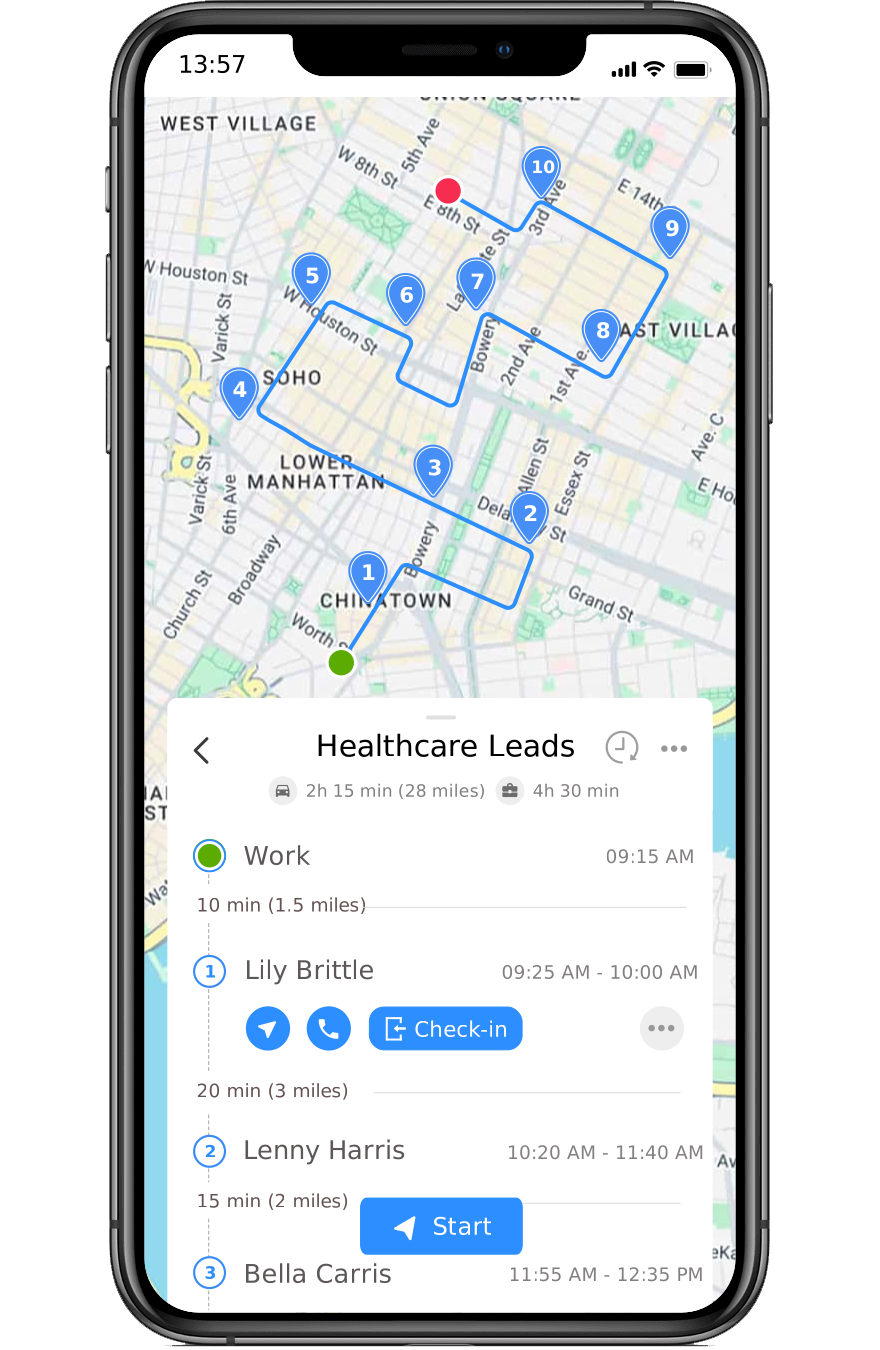
Egyptian sales teams work on the move and on WhatsApp. If logging a call means waiting until they are back at a laptop, it will not happen. The Zoho CRM mobile app lets reps log a call, add a note or move a deal stage in seconds after a meeting. Connect WhatsApp as well, so conversations land on the customer record automatically, as covered in our guide to WhatsApp CRM for Egyptian sales teams.
Pay From the CRM
People take seriously what affects their income. When commission and target achievement are calculated directly from closed deals in the CRM, every rep has a reason to keep records accurate. Our post on sales commission automation explains how to set this up. The message to the team is simple: if it is not in the CRM, it did not happen. Apply the same rule to targets and bonuses, and disputes over who closed what largely disappear, because the record shows who owned the deal at each stage.
Automate the Admin Away
A CRM should save a rep time, not cost it. Automatic lead assignment, follow-up tasks created after each stage, and reminders for overdue deals remove the busywork. In addition, Zoho CRM Blueprints guide each rep through the next step instead of expecting them to remember the process. When the system does the remembering, reps start to rely on it.
Train by Role, Not by Feature
A single two-hour session covering every menu is forgotten by Monday. Instead, train each role on the five things it does every day: a rep on logging calls and moving deals, a manager on dashboards and coaching. Back this up with short written procedures and one internal champion per team who answers questions. Coaching from real CRM data, covered in our post on sales coaching with Zia, keeps the training going after launch.
Measure Adoption and Make It Visible
What gets measured gets done. Track simple adoption numbers each week: logins per rep, calls logged, deals updated within 24 hours, and overdue tasks. Share them with the team. For a lighter touch, Gamescope for Zoho CRM turns daily activity into team games, with trophies and badges for converting leads, making calls and completing tasks.
A 90-Day CRM Adoption Plan
The first three months decide whether a CRM becomes a habit. This plan works for most mid-sized sales teams:
| Period | Focus | What success looks like |
|---|---|---|
| Days 1–30 | Role-based training, mobile app on every phone, weekly meeting moved into the CRM | Every rep logs calls in the CRM; no Excel in meetings |
| Days 31–60 | Remove unused fields, add automation, appoint champions | Deals updated within 24 hours for most reps |
| Days 61–90 | Commission and targets calculated from the CRM, adoption numbers shared weekly | The CRM is the only place pipeline numbers come from |
Meanwhile, keep a short list of complaints from reps. Each one is either a training gap or a design problem, and both can be fixed. If you are still choosing whether to move off spreadsheets at all, our comparison of CRM vs Excel for sales teams is a better starting point.
How PyramidBITS Builds CRM Adoption Into Implementation
Because adoption decides whether a CRM project pays off, PyramidBITS treats it as part of implementation rather than an afterthought. In practice, that means configuring Zoho CRM around how the team already sells, including WhatsApp, rather than asking the team to change everything at once. It also means role-based training and written procedures, so new hires learn the same way.
The same approach was used in PyramidBITS’s HR implementation for Sprints.ai, where change management combined guided demos, comprehensive training and written SOPs to move a growing team off spreadsheets.
CRM Adoption: FAQs
What is CRM adoption?
CRM adoption is the extent to which a team uses the CRM as part of its daily work, logging activity, updating deals and running meetings from it, rather than keeping parallel records elsewhere.
Why do sales teams resist using a CRM?
Usually because it feels like extra admin with no personal benefit. When the CRM saves reps time and affects their commission, resistance drops.
How long does CRM adoption take?
Most teams form the habit within about 90 days if leadership runs meetings from the CRM and the system is set up around the team’s real workflow.
How do you measure CRM adoption?
Track logins per rep, activities logged, deals updated within 24 hours and overdue tasks each week, and watch the trend rather than a single number.
Can a CRM work for teams that sell on WhatsApp?
Yes. Connecting WhatsApp to the CRM means conversations are stored on the customer record, so reps keep their channel and the company keeps the history.
Make the CRM the Easiest Way to Sell
CRM adoption is not won at go-live. It is won in the weeks after, when the system either saves reps time or costs it. Run meetings from it, keep it simple, put it on their phones, pay from it, and measure it. Do that, and the CRM stops being a reporting tool and becomes how your team sells.
Book a free Zoho CRM demo with PyramidBITS and see how a setup built around your team’s daily work looks.