Introduction
Ask a marketing manager and a sales rep, separately, what makes a lead “ready,” and you’ll usually get two different answers — not because either is wrong, but because the line between an MQL and an SQL is a debate at most companies, not a system.
The MQL to SQL transition is where marketing-sales alignment either holds up or falls apart in practice, and it’s one of the more fixable parts of the whole handoff problem, given the right configuration. Fixing it doesn’t require a philosophical agreement on what “quality” means in the abstract — it requires a specific, enforced threshold both teams actually use.
MQL vs SQL: The Difference That Actually Matters
A Marketing Qualified Lead (MQL) has shown real interest — downloading a guide, attending a webinar, revisiting the pricing page multiple times — but hasn’t been vetted for actual buying readiness yet.
A Sales Qualified Lead (SQL) has been checked against specific criteria — budget, authority, need, timeline — and is considered genuinely ready for a direct sales conversation. In the mql vs sql debate that plays out in most companies, the disagreement usually isn’t about the definitions themselves — most teams can recite them — it’s about where exactly the mql to sql threshold sits, and who decides a specific lead has crossed it.
Why the MQL to SQL Handoff Breaks Down So Often
Without an enforced system, this handoff degrades predictably. Marketing, measured on lead volume, has an incentive to call leads “qualified” generously. Sales, measured on closed revenue, has an incentive to reject anything that isn’t obviously ready — because chasing a bad SQL wastes time against quota.
Left to informal judgment calls, these two incentives pull in opposite directions every single week, and the argument about “your leads aren’t good enough” versus “sales isn’t following up” repeats indefinitely because nothing is actually forcing a shared, consistent standard.
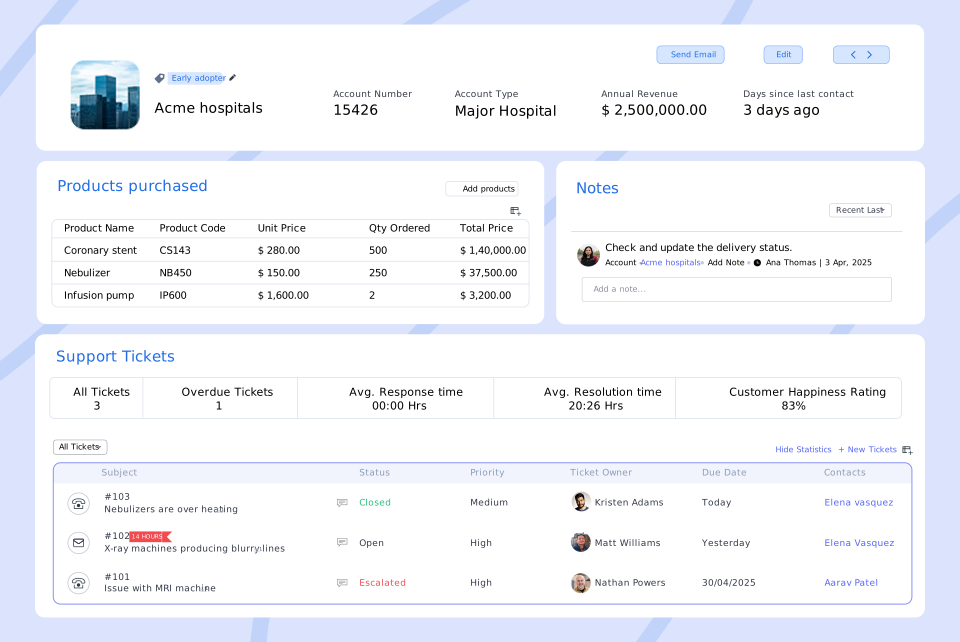
How MQLs Become SQLs Inside Zoho CRM
Behavioral scoring builds the MQL threshold automatically.
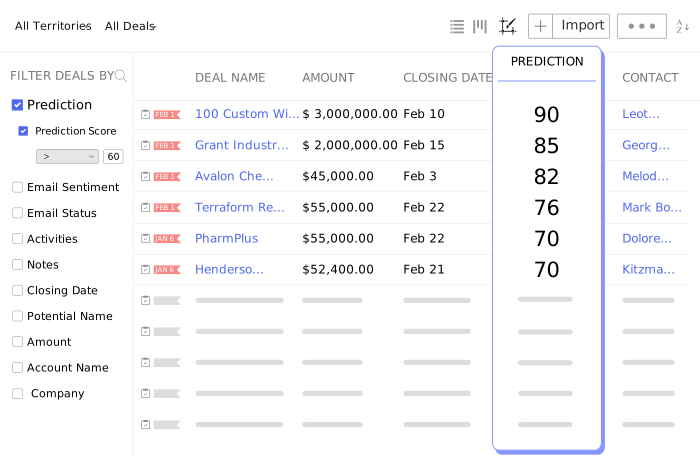
Zia AI scores leads based on real engagement signals — page visits, email opens, content downloads — so “marketing qualified” is a calculated score crossing an agreed number, not a subjective judgment call made lead by lead.
Explicit criteria fields capture SQL readiness.
Budget, authority, need, and timeline can be captured as required fields on the lead or deal record, so “sales qualified” means those specific criteria are documented — not just a rep’s gut feeling that a call went well.
Blueprints enforce the checklist before a lead can advance.
A Blueprint transition can require the SQL criteria fields to be completed before a record moves to the next stage, preventing a lead from being called “sales qualified” without the qualifying work actually happening.
Automatic handoff replaces the informal notification.
Once a lead crosses the SQL threshold, it can be automatically assigned and flagged for the right sales rep — no manual email, no lead sitting in a shared list waiting for someone to notice it qualified.
The result, as Adobe’s own guidance on lead qualification describes it, is that both teams need to agree on scoring criteria in advance and communicate regularly around the handoff — Zoho CRM’s role is making that agreement enforceable automatically, rather than something both teams have to remember and honor manually every single time.
Building Your Own MQL-to-SQL Criteria
There’s no universal MQL or SQL definition that fits every company — the right criteria depend on your sales cycle, product, and buyer journey. A reasonable starting point for your own mql to sql process: define MQL as a lead crossing a specific behavioral score threshold (say, downloading a pricing guide plus visiting the site three times in two weeks), and define SQL as a lead where a rep has confirmed budget authority and a genuine timeline in a real conversation.
The specific numbers matter less than both teams agreeing on them together and revisiting them once real conversion data comes in — a threshold set once and never adjusted tends to drift out of sync with reality within a couple of quarters.
Companies with seasonal sales cycles should expect to revisit this more often than companies with steady, year-round demand, since buying signals that indicate urgency in one season may just reflect normal browsing in another.
The PyramidBITS Implementation Angle
Configuring MQL-to-SQL scoring well requires marketing and sales in the same room, not a generic scoring template applied without input from either side. PyramidBITS’s approach includes:
- Facilitating the joint criteria-setting conversation, since a scoring model marketing builds alone rarely reflects what sales actually needs to see before accepting a lead.
- Configuring Zia’s scoring model around your specific behavioral signals — our Zoho CRM marketing automation guide covers how lead scoring connects to campaign data specifically.
- Building Blueprint enforcement for the SQL qualification checklist, so criteria fields can’t be skipped under deal-closing pressure — our complete guide to Zoho CRM Blueprints covers the underlying mechanism.
- Setting up conversion reporting so both teams can see MQL-to-SQL conversion rates over time and adjust criteria based on real data, not assumptions — our guide to advanced analytics in Zoho CRM covers this reporting layer. For companies with longer, more complex B2B cycles, our complete guide to Zoho CRM for B2B sales covers how this fits into multi-stakeholder deals specifically.
None of this replaces the judgment either team brings to individual deals — it just makes sure that judgment operates against a shared, documented standard instead of two different private ones.
[Insert Image 4 — alt text: “marketing sales team building mql to sql criteria together”]
Practical Next Steps
Before configuring scoring rules, these steps make the criteria-setting conversation productive:
- Pull your last 20 “qualified” leads that sales actually worked and identify what they had in common — this becomes the real-world basis for scoring criteria, not a theoretical model.
- Ask sales specifically what information they need before accepting a lead. Budget confirmation? A named decision-maker? Get this in writing before building anything.
- Set an initial MQL score threshold and commit to reviewing it after 60–90 days of real data, rather than treating the first version as permanent.
- Agree on what happens when a lead is borderline — neither clearly MQL nor SQL — so reps aren’t making inconsistent individual judgment calls on edge cases.
FAQs
What’s the difference between an MQL and an SQL?
An MQL (Marketing Qualified Lead) has shown genuine interest through engagement behavior but hasn’t been vetted for buying readiness. An SQL (Sales Qualified Lead) has been checked against specific criteria — budget, authority, need, timeline — and is considered ready for a direct sales conversation.
How does Zia AI help with MQL to SQL qualification?
Zia scores leads based on real behavioral signals, turning “marketing qualified” into a calculated, consistent threshold rather than a subjective call made differently by different people.
Can Zoho CRM prevent a lead from being marked SQL without proper qualification?
Yes, when configured with Blueprints. A transition can require specific fields — like confirmed budget or timeline — to be completed before a lead can advance to SQL status, closing the gap where reps mark leads qualified without doing the actual qualifying work.
How do we know if our MQL-to-SQL threshold is set correctly?
Track MQL-to-SQL conversion rate and SQL-to-closed-won rate over time. If sales is rejecting most “qualified” leads, the threshold is too loose. If very few MQLs ever become SQLs despite strong engagement, it may be too strict.
Should marketing or sales own the MQL-to-SQL definition?
Neither, alone. A definition set unilaterally by either team tends to serve that team’s incentives rather than the shared goal — the criteria need to be agreed jointly and revisited together as real conversion data comes in.
What happens to leads that never become SQLs?
They shouldn’t just disappear. Leads that plateau as MQLs without progressing are typically moved into a longer-term nurture track — ongoing content and light touchpoints — rather than either abandoned entirely or forced into sales’ queue before they’re genuinely ready, which wastes a rep’s time on a conversation unlikely to convert.
Book a Free CRM + AI Consultation
If your MQL-to-SQL line is still a debate between two teams instead of a system both can rely on, that’s worth fixing before the next quarter’s targets get set.
Book a free CRM + AI consultation with PyramidBITS and see how Zia-driven scoring and Blueprint enforcement can turn that debate into a shared, working process both teams actually trust.