Introduction
A customer confirms a large order. Sales is happy, the plant manager starts planning, and then the hard questions arrive. Do we have enough raw material for the whole run? Which machine is free next week? And what will each unit actually cost once labour, scrap and overtime are added? In many Egyptian factories, those answers live in three spreadsheets and one experienced person’s head. Manufacturing resource planning exists to replace that guesswork with one connected plan.
This guide explains what manufacturing resource planning (MRP II) is, what it costs a factory to run without it, and what changes when orders, materials, machines and money finally sit in the same system.
What Is Manufacturing Resource Planning (MRP II)?
Manufacturing resource planning is a way of planning everything a factory needs to deliver an order, not just the materials. It grew out of material requirements planning (MRP) in the 1980s. Classic MRP answered one question: what do we need to buy, and when? However, it ignored whether the plant had the machine hours, people and cash to execute that plan.
MRP II closed that gap. According to ERPResearch’s definition of MRP II, it adds capacity planning, shop floor control, demand forecasting and a financial feedback loop, so the production plan ties directly to budgets and the general ledger. In other words, MRP plans materials, while manufacturing resource planning plans the whole manufacturing operation.
Here is the difference in practical terms:
| Question | MRP (material requirements planning) | MRP II (manufacturing resource planning) |
|---|---|---|
| What materials do we need, and when? | Yes | Yes |
| Can our machines and workers handle the plan? | No | Yes (capacity planning) |
| Where is each order on the shop floor right now? | No | Yes (shop floor control) |
| What does this order really cost us? | Partly | Yes (costing linked to accounting) |
| What happens if we accept one more order? | No | Yes (“what-if” planning) |
Today, most factories don’t buy MRP II as a separate product. Instead, it lives inside an ERP system, where manufacturing, inventory, purchasing and accounting share one database. That is why the terms MRP, MRP II and ERP are often used loosely together.
The Real Cost of Running a Factory Without MRP II
Factories rarely fail because of one big mistake. Instead, they lose margin through small gaps that repeat every week. Without manufacturing resource planning, five of them show up again and again.
Cost per order is estimated, not known
When material consumption, labour time and scrap are recorded in different places, nobody can say what a specific order really cost. As a result, pricing is based on last year’s averages. Some orders quietly lose money, and the loss only appears at month-end, if at all.
Raw material runs out mid-run
A planner checks stock on Sunday, but purchasing used part of it for another order on Monday. By Wednesday, the line stops waiting for a component. Every stoppage means idle workers, missed delivery dates and, often, expensive urgent purchases.
Machines are overloaded one week and idle the next
Without capacity planning, orders are accepted based on what sales promised, not on what the work centers can handle. Consequently, the plant swings between overtime and idle time, and both cost money.
Delivery dates are promises, not plans
When sales asks “when can we deliver?”, the answer usually depends on who picks up the phone. Missed dates damage relationships with distributors and large buyers, especially in export and B2B supply chains.
Month-end numbers don’t match the floor
Finance closes the month with inventory values that don’t reflect what actually happened on the line. Variances are discovered weeks late, when it is too late to correct the cause.
Why Egyptian Factories Feel This More in 2026
These gaps matter more when demand is uncertain and input costs move quickly. That is the situation many Egyptian manufacturers face this year. The S&P Global Egypt PMI fell to 47.2 in September 2026 from 49.6 in August, signalling a renewed deterioration in non-oil private sector conditions, as Egypt Today reported. Purchasing activity also contracted at its sharpest pace since September 2023, and input inventories declined.
For a factory, that combination is risky. When companies buy less and hold less stock, there is less buffer to hide planning mistakes. A shortage that used to be absorbed by extra inventory now stops the line. Similarly, when margins are under pressure, an order priced on a wrong cost estimate hurts more.
Manufacturing resource planning doesn’t fix the market. It does, however, give owners and plant managers a clear view of three things they can control: what each order costs, what the plant can realistically produce, and what needs to be bought before it becomes urgent.
The Five Building Blocks of Manufacturing Resource Planning
Every manufacturing resource planning setup rests on the same building blocks. Each one replaces a specific manual habit with a specific business outcome.
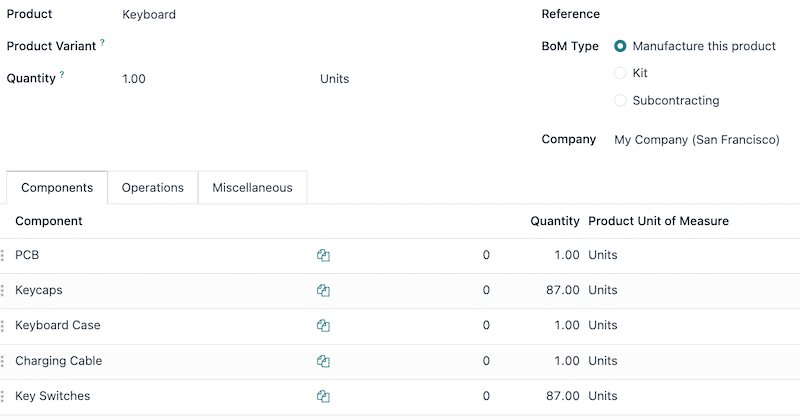
Bill of materials (BoM)
The bill of materials lists every component and quantity needed to make one unit, including sub-assemblies. When the BoM is accurate, the system can calculate exactly what an order needs.
Outcome: purchasing buys the right quantities, and cost per unit is calculated from real consumption instead of averages.
Routings and work centers
Routings describe the steps a product goes through, and work centers are the machines or lines that perform them, each with its own capacity and hourly cost.
Outcome: the plan reflects real machine time, so labour and overhead are included in the product cost.
Master production schedule (MPS)
The master production schedule turns sales forecasts and confirmed orders into a plan of what to produce, how much, and when.
Outcome: production and purchasing work from the same plan instead of reacting to the latest phone call.
Capacity planning
Capacity planning checks whether the work centers can actually deliver the schedule.
Outcome: sales can promise realistic delivery dates, and overtime becomes a decision rather than a surprise.
Costing linked to accounting
Finally, actual material, labour and scrap are posted against each manufacturing order and flow into accounting.
Outcome: the owner sees margin per order and per product while there is still time to act, not after the month closes.

How Manufacturing Resource Planning Works in Odoo
Odoo is an ERP platform that brings these building blocks together, with its Manufacturing app connected to Inventory, Purchase, Sales and Accounting. In practice, manufacturing resource planning in Odoo covers the following areas, with the exact scope depending on the edition and how the system is set up:
- Bills of materials: multilevel BoMs, product variants, kits and by-products. As a result, a confirmed sales order can calculate the components it needs automatically.
- Work centers and work orders: each step is scheduled on a work center, and operators log time from the shop floor. This means planners see where every order is without walking the floor.
- Master production schedule: in Odoo’s Manufacturing app, the MPS is used to plan manufacturing orders and purchase orders based on forecasted quantities, as described in Odoo’s master production schedule documentation. Consequently, buying starts before shortages appear.
- Replenishment rules: reordering rules, make-to-order and lead times trigger purchase or manufacturing orders when stock drops below the level you set.
- Manufacturing order and work-in-progress costs: material and labour costs are recorded per order, so finance and the plant manager look at the same margin figure.
- Reporting: delay, allocation, production analysis and equipment effectiveness reports show where capacity is being lost.
Because these apps share one database, a single event updates everyone. When a manufacturing order consumes components, stock levels change, purchasing sees the new requirement, and accounting records the cost. That connection is the practical meaning of manufacturing resource planning: one plan, many departments, no re-typing.
For a deeper look at the Manufacturing app itself, see our Odoo Manufacturing guide for Egyptian industries and the Odoo Manufacturing solution page.
A Practical Rollout Plan for Your Factory
Manufacturing resource planning works best when it is introduced in stages. Trying to switch every process on day one usually overwhelms the team. A phased approach looks like this:
- Clean the master data first. Agree on product codes, units of measure and one approved BoM per product. Bad BoMs produce bad plans, no matter how good the software is.
- Start with inventory and purchasing. Get stock levels accurate and reordering rules in place. This alone reduces mid-run shortages.
- Add manufacturing orders and BoMs. Run real orders through the system so material consumption is recorded per order.
- Introduce work centers and capacity. Once orders flow, add routings and machine capacity so delivery dates become reliable.
- Connect costing to accounting. Finally, link manufacturing costs to the ledger so margin per order is visible every week.
Throughout the rollout, train the people who will use the system daily, not only managers. Planners, storekeepers and line supervisors decide whether the data stays accurate. This is where an implementation partner earns its value: mapping your real workflow, configuring the system around it, and supporting the team in Arabic until the new routine sticks. To see how that process typically runs, read our overview of Odoo ERP implementation for Egyptian businesses.
Signs Your Factory Is Ready for Manufacturing Resource Planning
Not every workshop needs a full system on day one. However, if several of these statements describe your plant, spreadsheets are already costing you more than they save:
- You can’t say the real cost of last month’s biggest order.
- Production stops at least once a month waiting for material.
- Delivery dates are regularly renegotiated with customers.
- Stock in the system and stock on the shelf don’t match after a count.
- Planning depends on one or two people who “know everything”.
- Month-end closing takes days of reconciling production and accounting sheets.
If three or more apply, manufacturing resource planning will likely pay back quickly through fewer stoppages, more accurate pricing and less overtime. To understand where Odoo fits in a wider transformation, our guide to digital transformation for SMEs is a good next read.
Frequently Asked Questions
What is the difference between MRP and manufacturing resource planning?
MRP (material requirements planning) calculates which materials to buy and when, based on the bill of materials and demand. Manufacturing resource planning (MRP II) extends that to machine capacity, labour, shop floor tracking and costing, so the plan is checked against real plant resources and linked to finance.
Is manufacturing resource planning the same as ERP?
Not exactly. ERP is broader and also covers areas such as sales, HR and accounting across the whole company. Manufacturing resource planning is the production planning logic inside it. In a modern ERP such as Odoo, MRP II is delivered through the Manufacturing app working together with Inventory, Purchase and Accounting.
Do small and mid-sized Egyptian factories need MRP II?
Size matters less than complexity. A factory with several products, shared machines and frequent material shortages benefits even with a small team. A single-product workshop with stable demand may only need inventory and purchasing control at first.
How long does it take to implement manufacturing resource planning?
It depends on the number of products, the quality of existing data and how many stages you roll out at once. A phased approach, starting with inventory and BoMs, lets a factory see results from the first stage instead of waiting for a full go-live.
Can Odoo handle multilevel bills of materials?
Yes. Odoo’s Manufacturing app supports multilevel BoMs, product variants, kits and by-products, so sub-assemblies can be planned and costed within the same order.
Turn Guesswork into a Plan
When cost per order is estimated, shortages are discovered on the line and delivery dates are negotiated by phone, the factory is paying for missing information every day. Manufacturing resource planning connects orders, materials, machines and money, so decisions are made on real numbers rather than memory.
PyramidBITS helps Egyptian manufacturers implement Odoo around how their plant actually works, one stage at a time, with local support for the team.
Book a free demo with PyramidBITS and see how manufacturing resource planning in Odoo would look with your products and your production flow.