Most sales managers eventually land on one of two approaches: constant check-ins that make the team feel watched, or a hands-off style that feels respectful right up until a quarter goes badly and nobody can explain why. Neither actually works, and the reason is the same in both cases — checking in more often and checking in less often are both attempts to solve a visibility problem with a management style, when visibility is actually a systems problem.
Sales automation exists to close that gap directly, without either extreme, and this closing post pulls together the automation, scoring, and process pieces covered throughout this series into that one underlying idea.
Why Micromanaging and Hands-Off Management Are Both Wrong
Micromanaging fails for reasons most managers already sense: it signals distrust, it consumes time better spent coaching or closing, and it tends to produce reps who report good news rather than real news. But the opposite extreme fails just as badly — a manager who steps back entirely loses the early warning signs that let them intervene while a problem is still fixable, and by the time results make the issue visible, it’s usually too late to do much about it.
Both extremes, ironically, come from the same good intention: wanting the team to succeed. They just aim that intention at the wrong lever — management style — instead of the actual gap, which is information. Gallup’s research on manager behavior notes that managers drive roughly 70% of the variance in team engagement — and that when managers don’t have a structured way to have meaningful, specific conversations, their attempts at oversight get perceived as micromanagement even when that isn’t the intent.
The problem often isn’t the manager’s instincts. It’s the absence of a system that makes real activity visible without requiring a manager to ask for it constantly.
What Real Accountability Actually Requires
Real accountability isn’t surveillance, and it isn’t hoping for the best. It requires three specific things: activity that’s visible without anyone having to ask for a status update, a process consistent enough that “how things are supposed to go” isn’t a matter of interpretation, and early warning when something is going off track — while there’s still time to help, not just time to note it in a post-mortem.
None of these three things require a manager standing over anyone’s shoulder. They require the system itself to make the relevant information visible automatically.

How Sales Automation Builds Accountability In
Activity gets logged automatically, not reported manually
Calls, emails, and WhatsApp conversations tied to a deal get captured as they happen, so a manager can see real activity without asking a rep to summarize their week — which also means the record reflects what actually happened, not a flattering recap.
Blueprints make the process consistent without a manager enforcing it personally
When required fields and approvals are built into stage transitions, “did you actually confirm the budget” stops being a question a manager has to remember to ask every single deal — the system already requires the answer before the deal can move forward.
Shared dashboards replace the status-update meeting
When both the manager and the rep look at the same live pipeline data, accountability becomes mutual and visible rather than something delivered top-down in a weekly check-in nobody enjoys.
Zia AI flags problems before they become visible in results
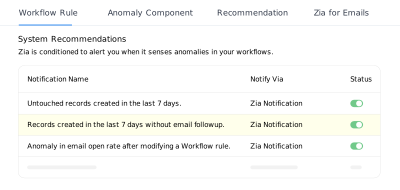
Rather than a manager needing to notice a deal has gone quiet, Zia’s anomaly detection surfaces deals behaving differently than similar historical deals — early enough to actually help, not just early enough to note what went wrong afterward.
What This Looks Like Day to Day
Without this system, a manager’s week involves asking each rep for updates, hoping the answers are accurate, and finding out about problems only when a deal is already lost or a quarter is already missed. With sales automation properly configured, that same manager opens one dashboard and sees exactly where every deal stands, which reps have deals stalling, and which conversations went quiet — without a single check-in call.
The rep experience changes too: instead of feeling watched, they’re working inside a system that makes their real progress visible on its own, which — done well — actually reduces the felt pressure of oversight rather than increasing it.

The PyramidBITS Implementation Angle
Sales automation only builds genuine accountability if it’s configured to surface the right signals — badly configured, it either shows too little to be useful or floods a dashboard with noise nobody checks. PyramidBITS’s approach includes:
- Identifying what visibility a manager actually needs, not a generic dashboard template copied from a demo account.
- Configuring Blueprints around real process requirements, so consistency is built in without creating friction that causes the team to route around the system — the same discipline covered in our piece on why growing sales teams outgrow spreadsheets.
- Setting up Zia’s anomaly detection against your team’s actual historical patterns, so alerts are meaningful rather than generic noise.
- Training managers to lead from the dashboard, replacing status-update meetings with coaching conversations grounded in real data — the same shift behind why B2B sales deals stall without this kind of visibility, and the same principle our complete guide to Zoho CRM for real estate covers for broker teams specifically. For companies managing complex B2B cycles, our complete guide to Zoho CRM for B2B sales covers this in more depth.
Practical Next Steps
Before configuring any dashboard or automation, these steps clarify what accountability actually looks like for your team — and are worth doing as a genuine team conversation, not a solo planning exercise:
- List the three things you most want visibility into — response speed, deal progression, activity volume — rather than trying to track everything at once.
- Ask your team, honestly, whether current check-ins feel like support or surveillance. Their answer tells you which extreme you’re currently closer to.
- Identify your last “we didn’t see it coming” problem and work backward to what signal, if visible earlier, would have caught it.
- Pick one status-update meeting to replace with a shared dashboard as a starting point, rather than overhauling everything at once.
FAQs
How is sales automation different from just monitoring employees more closely?
Monitoring adds oversight without changing the underlying visibility problem — someone still has to watch and interpret. Sales automation makes relevant activity and pipeline data visible automatically, reducing the need for anyone to actively watch in the first place.
Will my sales team feel more watched with sales automation in place, not less?
Done well, the opposite tends to happen — reps report feeling less watched because the system removes the need for a manager to ask for constant manual updates. The key is configuring visibility around genuinely useful signals, not turning the CRM into a surveillance tool.
What’s the difference between accountability and micromanaging?
Accountability is visibility into outcomes and process with room for a rep to work their own way within it. Micromanaging is controlling how every individual task gets done. Sales automation supports the former by making results and process adherence visible without dictating every step a rep takes.
Can Zia AI replace a manager’s judgment about a struggling rep?
No — it surfaces signals (stalled deals, unusual patterns) a manager might otherwise miss, but deciding how to coach or support a specific rep still requires human judgment Zia isn’t designed to replace.
How long does it take to set up accountability-focused sales automation?
The technical configuration — dashboards, Blueprints, Zia’s anomaly detection — can be done in a few weeks. The more important part is deciding, as a management team, what visibility actually matters before building it, which is a planning conversation more than a technical one.
Does this approach work for remote or hybrid sales teams specifically?
It arguably matters more for remote teams, since informal visibility — overhearing a call, noticing body language in the office — disappears entirely when a team isn’t physically together. Sales automation’s value is less about replacing in-person observation and more about creating visibility that doesn’t depend on physical proximity in the first place.
Book a Free Zoho CRM Demo
If your current choice is between checking in too much or not enough, that’s a sign the visibility itself is missing, not a management style problem — and it’s not a choice you should have to keep making every quarter.
Book a free Zoho CRM demo with PyramidBITS and see what real accountability looks like without either extreme.