Introduction
Most sales coaching software conversations start with a manager listening in on a couple of calls a month, usually whichever ones they happen to have time for, and giving feedback based on that small, unrepresentative sample. The rep who’s struggling quietly might get overlooked entirely, while the rep who complains loudest gets the most attention. This isn’t a management failure — it’s what happens by default without data showing who actually needs coaching, on what, and how urgently.
Why Most Sales Coaching Runs on Gut Feeling
Coaching based on whichever calls a manager happens to catch is coaching based on a sample size too small to be reliable. A rep who’s brilliant on the two calls a manager overheard might be inconsistent on the twenty they didn’t.
Meanwhile, patterns that would be obvious across a rep’s full activity — consistently slow follow-up, a specific objection they never handle well, emails that go unanswered without a second attempt — stay invisible without a system surfacing them.
The manager isn’t failing to coach; they’re coaching blind, because the alternative (reviewing every call manually) doesn’t scale past a handful of reps.
What Data-Driven Sales Coaching Actually Requires
The gap between gut-feel and data-driven sales coaching software isn’t small. Research reported by Ambition, citing Gartner, found that teams using data-driven coaching are 2.2 times more likely to achieve quota than teams that aren’t.
But the data also comes with an honest nuance worth knowing before investing heavily: Harvard Business Review research, as reported by Prolifiq, found that coaching produced almost no measurable improvement for a team’s top and bottom 10 percent — the real payoff showed up in the middle 60-70 percent of a sales team, where coaching drove meaningful performance gains.
Coaching isn’t a universal fix; it’s most valuable applied to the reps in the middle who have real room to close the gap between where they are and where the top performers already sit.

[Insert Image 2 — alt text: “data driven sales coaching quota attainment research”]
How Zia Turns Call and Email Data Into Coaching Signals
Email engagement patterns become visible, not anecdotal
Instead of a manager guessing whether a rep follows up consistently, Zia surfaces actual response times, follow-up frequency, and email engagement across a rep’s full activity — not just the handful a manager happened to notice.
Sentiment trends flag conversations worth a second look
Zia’s sentiment analysis on email exchanges can flag when a conversation is trending negative, giving a manager a specific, real example to coach around instead of a vague “your calls could be better.”
Activity patterns reveal coaching-worthy gaps at scale
A rep who consistently takes longer to follow up, or whose deals stall at a specific stage more often than peers, shows up in the data — a pattern no manager would catch reviewing individual calls one at a time.
Existing PyramidBITS client data backs this up directly
Email integration and tracking alone has been shown to save each sales rep over 5 hours per week, time managers can reinvest in the coaching conversations this data actually points them toward, rather than manual activity tracking that consumes the very time it’s meant to free up.
The Technical Reality — What Your Calls Need to Look Like First
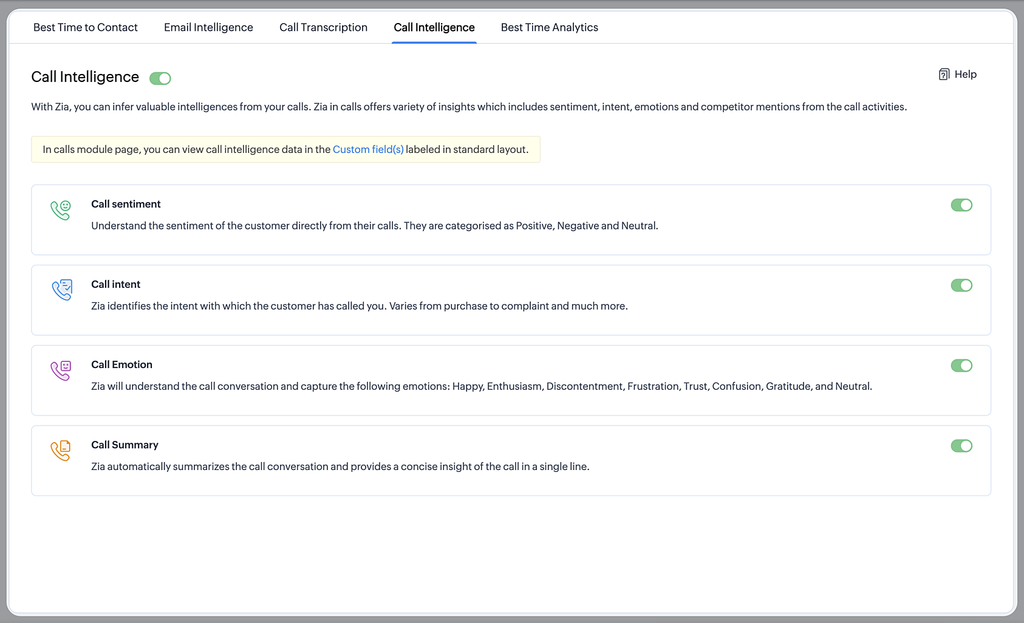
Here’s the honest caveat: Zia’s AI capabilities work on data that’s actually inside the CRM — which means call-based coaching signals depend on calls being logged there in the first place. For teams using an integrated VoIP or telephony system connected to Zoho CRM, this happens automatically.
For teams where reps make calls from personal or unconnected mobile phones, call data doesn’t log itself — it requires either a telephony integration or a genuine habit of manual logging, and coaching signals are only as good as the underlying data feeding them.
Confirming which situation your team is in before promising “AI coaching” avoids setting an expectation the current setup can’t actually deliver on day one.
Practical Next Steps
Before expecting AI-driven coaching signals, these steps clarify where you’re actually starting from — and are worth running honestly, since overestimating current data quality is the most common reason coaching rollouts disappoint in the first quarter:
- Check how many of your team’s calls are currently logged in the CRM, not just made. A low percentage means coaching signals will be incomplete regardless of what Zia can technically do.
- Ask your team how coaching feedback currently gets delivered — informally in a hallway conversation, or in a documented, trackable way. The former doesn’t scale past a few reps.
- Identify your middle-performing reps specifically, not just your top or bottom performers — this is where coaching investment research shows the strongest return.
- Pick one coaching metric to track consistently for 90 days — follow-up speed, email response rate, deal-stage stall points — rather than trying to coach on everything at once.
FAQs
What is sales coaching software?
Sales coaching software uses activity data — calls, emails, deal progression — to surface patterns and feedback opportunities managers can act on, replacing coaching based on a small, informal sample of observed interactions. Zoho CRM’s Zia AI provides much of this functionality natively, tied to email tracking and engagement data covered in our Zoho CRM marketing automation guide.
Does Zia AI record and analyze sales calls directly?
Zia analyzes data already present in the CRM, including email engagement and activity patterns. Call-specific analysis depends on calls being logged into the CRM, typically through a connected telephony integration — it isn’t automatic for calls made outside that system.
Is data-driven sales coaching worth it for every rep on a team?
Research suggests it delivers the strongest impact for reps in the middle of the performance range, with less measurable effect on a team’s very top and very bottom performers. Coaching investment is often best prioritized accordingly, rather than spread evenly across the entire team — a manager with limited time each week gets more return focusing on the reps with the most room to close a specific, identifiable gap.
How does this differ from a dedicated conversation-intelligence platform like Gong or Chorus?
Dedicated conversation-intelligence platforms specialize in deep call transcription and analysis as their core product. Zia’s coaching signals come from the broader CRM activity data — email, deal progression, engagement patterns — which covers meaningful ground for most teams without adding a separate specialized tool, though very call-heavy sales organizations may still want both.
How quickly can a sales team start seeing useful coaching data?
Once call and email logging are properly connected, coaching-relevant patterns typically become visible within the first few weeks of activity — though the value compounds over time as more historical data accumulates for comparison. Teams evaluating sales coaching software often expect instant results, but the honest timeline is closer to a full sales cycle before patterns become genuinely reliable rather than noisy.
Book a Free Zoho CRM Consultation
If coaching in your sales team currently depends on whichever calls a manager happened to catch, that’s a data problem sales coaching software can genuinely fix.
Book a free Zoho CRM consultation with PyramidBITS and find out exactly what your team’s current call and email logging can already tell you.