Introduction
Your marketing team is doing its job. Ads are running, forms are filling up, WhatsApp inquiries are coming in. Then somewhere between “lead captured” and “sales rep calls back,” a large share of those leads simply disappear. No one deleted them. No one decided to ignore them. They fell into the gap between two teams that were never actually connected by one system — and that gap is usually a missing lead management system, not a missing sales effort.
This is one of the most common and most expensive problems in growing companies, and it rarely gets diagnosed correctly. Leadership sees a marketing report showing strong lead volume, then a sales report showing weak conversion, and assumes the sales team isn’t working hard enough. In most cases, that’s the wrong conclusion. The real issue is what happens — or doesn’t happen — in the minutes and hours after a lead is captured. This is exactly why interest in crm software Egypt searches has been rising: companies are realizing the tool matters as much as the effort.
The Marketing-to-Sales Handoff Is Where Leads Actually Die
Every company with a marketing team and a sales team has a handoff moment: the point where a lead generated by marketing becomes a lead worked by sales. When that handoff is manual — an Excel export, a WhatsApp forward, a daily email dump — it becomes the single weakest point in the entire revenue process.
A few things typically happen at that handoff point:
- Leads sit unassigned for hours, sometimes days, because no one owns the responsibility of distributing them the moment they arrive.
- The same lead gets contacted by two different reps, or by no one, because there’s no shared visibility into who is working what.
- Context gets lost. Marketing knows which ad, offer, or page converted the lead. By the time sales calls, that context rarely survives the handoff, so the first call sounds generic instead of relevant.
- Follow-up speed drops. A lead that arrives on WhatsApp at 6 PM might not reach a sales rep until the next working day.
The cost of that delay is well documented outside Egypt too. Research published in Harvard Business Review analyzed thousands of companies’ response times to web-generated leads and found that most took hours — sometimes days — to make first contact, and that the odds of ever qualifying a lead drop sharply the longer that first response is delayed. None of this is a people problem. It’s a systems problem. Without a proper lead management system connecting marketing capture to sales follow-up, companies are relying on individual discipline to do what software should be doing automatically.
What a Lead Management System Actually Needs to Do
A lead management system isn’t just “a place to store contacts.” For a company with real lead volume and an active sales team, it needs to do four specific jobs:
1. Capture leads from every channel automatically. Facebook and Instagram ads, website forms, WhatsApp inquiries, phone calls, walk-ins — all of it needs to land in one system the moment it happens, without anyone manually copying data from one place to another. This is the same principle behind how Zoho CRM handles the full customer journey from first click to close.
2. Distribute leads instantly, based on rules, not memory. The moment a lead arrives, it should be assigned to the right person — by product interest, region, or current workload — without a manager manually dividing the list every morning.
3. Preserve context across the handoff. The sales rep picking up the lead should immediately see where it came from and what the person showed interest in — not start the conversation from zero.
4. Make follow-up visible and measurable. Management needs to know, at any moment, how many leads are untouched and for how long — without waiting for a Friday report to find out something went wrong three weeks ago.
This is precisely the gap between marketing and sales that most Egyptian companies with growing lead volume are still trying to close manually — and precisely what a connected lead management system is built to solve.
How Zoho CRM Closes the Marketing-to-Sales Gap
Zoho CRM is built around exactly this handoff problem, not as an afterthought but as core functionality — which is a large part of why demand for crm software Egypt implementation partners is growing alongside it.
Automatic lead capture. Web forms, Facebook and Instagram lead ads, and WhatsApp Business all feed directly into Zoho CRM the moment a lead is submitted — no manual export, no delay. Our marketing automation guide for Zoho CRM covers this capture layer in more depth.
Rule-based lead distribution. Assignment rules route each lead to the right sales rep automatically, based on criteria the sales manager defines: product line, region, or current workload. For more complex, multi-stage processes, these rules can be extended using Zoho CRM Blueprints to enforce a consistent, repeatable sales process.
Full context carried forward. Every lead record keeps its source, campaign, and prior touchpoints attached, so the first conversation is relevant instead of generic.
Zia AI lead scoring. Zoho’s built-in AI assistant, Zia, scores leads based on behavior, engagement, and profile signals, so sales reps know which leads deserve the first call of the day instead of working the list in the order it happened to arrive.
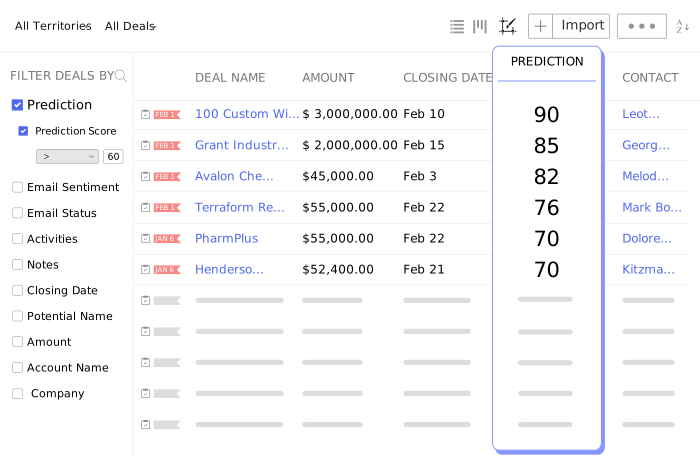
Dashboards that show the truth in real time. Sales managers and marketing managers can both see exactly how many leads are new, in progress, or untouched, and for how long. The handoff stops being invisible.
WhatsApp still works the way your team already uses it. Zoho CRM doesn’t ask companies to abandon WhatsApp as a lead channel — it connects to it, so every conversation is logged, assigned, and tracked as part of the same pipeline as everything else.
The result isn’t just “a CRM.” It’s a single connected lead management system where marketing’s work and sales’ work meet in the same place, instead of living in two disconnected worlds joined only by a spreadsheet someone forgot to update.
The PyramidBITS Implementation Angle
Buying Zoho CRM licenses does not, by itself, fix a broken marketing-sales handoff. The system has to be configured around how your specific teams actually work — which matters even more given how quickly Egyptian companies are moving on this. Industry research on Egypt’s cloud ERP and SME software market points to more than 60% of Egyptian SMEs now identifying a real need for digital tools, alongside a national push to grow the digital economy’s share of GDP — which means the companies that get their lead management system right early are the ones building a real advantage, not just catching up later.
As PyramidBITS, a Zoho Authorized Partner in Egypt, our implementation work covers:
- Mapping your actual lead sources and handoff process first, before touching a single setting, so the CRM reflects how your marketing and sales teams really operate.
- Building assignment rules specific to your business — by product, territory, or team structure.
- Connecting WhatsApp Business and your ad platforms so lead capture is fully automated from day one.
- Training both marketing and sales teams together, since the handoff problem is a shared responsibility.
- Ongoing support and localization, including Arabic interface and Egypt-specific workflow needs.
With PyramidBITS, companies don’t just get Zoho CRM turned on — they get a lead management system built around the way their marketing and sales teams are actually supposed to work together.
Practical Next Steps
If your company is dealing with this problem right now, here’s a realistic starting point before any software conversation:
- Pull last month’s lead numbers from marketing and compare them to sales’ contacted numbers. The gap between those two figures tells you how big the handoff problem actually is.
- Time how long it currently takes for a lead to reach a sales rep, from the moment it’s captured. If it’s measured in hours or days rather than minutes, that’s the leak.
- Ask your sales team how they currently know which lead to call next. If the honest answer is “whoever’s on top of the list,” there’s no real prioritization system in place.
- Map where leads currently live — ads platform, WhatsApp, Excel, a shared inbox — and count how many separate places a single lead passes through before a rep actually calls.
These four steps alone usually reveal exactly where the handoff is breaking, before a single line of configuration is written.
FAQs
What is a lead management system? A lead management system is software that captures leads from every channel — ads, web forms, WhatsApp, calls — and automatically organizes, distributes, and tracks them through to a sales outcome, instead of relying on manual handoffs between marketing and sales.
How is Zoho CRM different from just using a shared spreadsheet? A spreadsheet can store lead data, but it can’t assign leads automatically, track response time in real time, preserve campaign context, or alert anyone when a lead has gone untouched. A proper lead management system does all of this automatically.
Can Zoho CRM handle leads coming from WhatsApp specifically? Yes. Zoho CRM connects directly with WhatsApp Business, so conversations are logged, assigned, and tracked inside the same pipeline as leads from ads, forms, or calls.
Does Zia AI lead scoring work for companies with a smaller sales team? Yes. Zia’s scoring is based on lead behavior and engagement data, not company size, so even a small sales team benefits from knowing which leads to prioritize first.
How long does it take PyramidBITS to implement a marketing-to-sales handoff setup like this? Timelines vary by company complexity, but most implementations of this scope move from process mapping to a working, trained system within a few weeks — not months.
Book a Free Zoho CRM Demo
If leads are disappearing between your marketing and sales teams, the fix usually isn’t more marketing spend — it’s a proper handoff system. Book a free Zoho CRM demo with PyramidBITS and see exactly how lead capture, distribution, and follow-up can work as one connected process instead of three disconnected steps.