Introduction
HR software is no longer only about storing employee records, tracking attendance, and calculating payroll. The next stage of HR is AI-assisted work: systems that help HR teams screen candidates faster, detect risks earlier, answer questions quicker, and make better decisions with less manual effort.
For years, HR teams have been overloaded with administration.
They review hundreds of CVs, update employee data, follow up on leave requests, check attendance records, prepare payroll inputs, answer repeated employee questions, and build reports manually. As companies grow, this workload becomes harder to manage with Excel sheets, emails, and disconnected tools.
AI is changing that, but the right way to look at AI in HR is not “AI replacing HR.” That is the wrong framing. AI should work as an assistant.
It helps HR teams process information faster, spot patterns earlier, and reduce repetitive work. The final decision still belongs to people. Hiring, performance, payroll, employee experience, and culture are human decisions. AI can support those decisions, but it should not own them without review.
This is where Zia AI, Zoho’s AI assistant layer, becomes important for companies using Zoho HR solutions such as Zoho Recruit, Zoho People, and Zoho Payroll.
For Egyptian and MENA businesses, the opportunity is clear: HR teams can move from manual follow-up to AI-assisted HR operations.
Why AI in HR Is No Longer a Luxury
AI in HR used to sound like something only large enterprises could afford, that is no longer the case.
Today, even mid-sized companies face HR complexity that is difficult to manage manually. A growing company may need to handle recruitment, onboarding, employee records, attendance, shifts, overtime, leave approvals, payroll, performance, engagement, and reporting at the same time.
The challenge is not only workload. It is accuracy.
Manual HR work creates risks such as:
- Missing strong candidates because recruiters cannot review every CV properly
- Payroll mistakes caused by wrong attendance or deduction data
- Delayed reports because HR data is scattered
- Weak visibility into employee satisfaction
- Inconsistent performance evaluations
- Biased promotion or hiring decisions
- Repeated employee questions consuming HR time
- Managers making decisions without enough data
AI helps by turning HR software from a passive database into an active assistant.
Instead of waiting for HR to search, check, compare, and summarize manually, AI can help surface useful information at the right time.
From HR Software to Intelligent HR Operations
Traditional HR software helps companies digitize HR processes. That includes employee records, leave management, attendance, documents, payroll inputs, onboarding, and reporting. This is already valuable. But intelligent HR software goes further. It does not only store data. It helps HR teams use that data.
For example, a normal HR system may store all candidate CVs. An AI-assisted HR system can help rank candidates, summarize profiles, and suggest better matches.
A normal payroll system may calculate salary components. An AI-assisted payroll workflow can help detect unusual changes, missing inputs, or possible errors before payroll is finalized.
A normal performance system may collect appraisal scores. An AI-assisted talent management software setup can help identify patterns, inconsistencies, and possible bias.
This is the shift from “record keeping” to “decision support.” For HR teams, that shift is powerful because it reduces the gap between having data and acting on it.
Zia AI in Recruitment: Faster CV Screening and Candidate Matching
Recruitment is one of the clearest use cases for AI in HR.
Recruiters often receive large numbers of applications for one role. Manually reviewing every CV takes time, especially when the hiring team is looking for specific skills, experience, location, industry background, or seniority level. This is where Zia AI in Zoho Recruit can support the process.
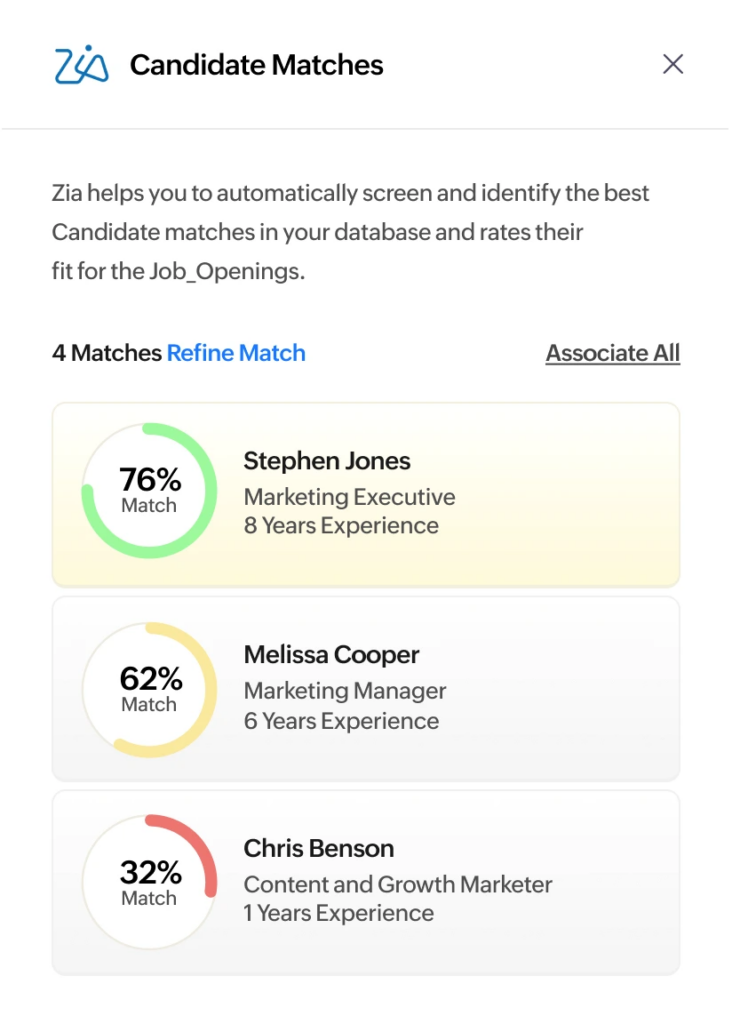
Zia can help analyze candidate profiles and match them with job requirements based on skills, experience, and job details. Instead of asking recruiters to manually screen every CV from scratch, Zia can help identify stronger matches faster.
This does not mean recruiters should stop reviewing candidates. It means recruiters can start from a more organized shortlist.
For example, Zia can help HR teams:
- Review candidate profiles faster
- Match candidates to job openings
- Generate candidate fit indicators
- Reduce manual CV filtering
- Prioritize stronger applications
- Save recruiter time during high-volume hiring
The business outcome is simple: faster hiring with less manual screening.
For companies that receive many applications through job portals, referral programs, email, and social media, AI-assisted recruitment can reduce the time wasted on unsuitable profiles and help recruiters focus on the candidates who deserve closer attention.
Zia AI and Candidate Quality: Better Shortlists, Not Blind Decisions
One important point: AI should not become a black-box hiring decision-maker. HR teams should use AI to support shortlisting, not to blindly reject people.
The best approach is human-in-the-loop hiring, which means Zia helps sort, summarize, and recommend, while recruiters and hiring managers make the final judgment. This matters because hiring is not only about keywords. It includes communication, culture fit, career direction, potential, motivation, and interview performance.
AI can help with structure. Humans should still decide.
This is the right balance for Egyptian companies that want faster recruitment without losing the human judgment behind hiring decisions.
Payroll Guard: Using AI to Catch Payroll Risks Before They Become Problems
Payroll is one of the most sensitive HR processes. One wrong number can affect employee trust, finance reports, compliance, and internal confidence in the HR team.
In many companies, payroll errors happen because the process depends on manual checks across attendance sheets, leave records, overtime, deductions, allowances, salary changes, and tax or insurance-related inputs.
A practical AI concept here is a Payroll Guard workflow.
The idea is simple: before payroll is finalized, AI helps review the payroll run for unusual patterns or missing information.
For example, an AI-assisted payroll guard can help flag:
- A sudden salary change
- Missing attendance data
- Unusual overtime
- Unexpected deductions
- Employees with incomplete payroll inputs
- Differences from the previous payroll cycle
- Manual edits that need review
- Employees with missing bank or profile data
This does not replace payroll review. It strengthens it.
Zoho Payroll, when connected with Zoho People, can already help reduce repeated manual data entry between employee records, attendance, and payroll workflows. When AI and agents are added as a review layer, HR and finance teams can move closer to a proactive payroll process.
Instead of discovering mistakes after payslips are issued, teams can catch risks before payroll is approved.
Sentiment Analysis: Understanding Employee Experience Earlier

Many HR teams only discover employee dissatisfaction when it is already too late.
An employee resigns, and only then does the company realize there were warning signs: low engagement, repeated complaints, poor manager communication, or frustration with workload. AI can help HR teams move earlier.
Sentiment analysis can help detect patterns in employee feedback, survey answers, HR tickets, internal comments, or engagement inputs. The goal is not to spy on employees. The goal is to understand workforce signals before they become retention problems.
For example, AI can help HR teams identify:
- Negative sentiment in survey responses
- Repeated complaints about a department
- Common themes in employee feedback
- Early signs of disengagement
- Differences between teams or branches
- Topics that require management attention
Used responsibly, sentiment analysis gives HR teams a better way to listen. It helps move employee experience from reactive problem-solving to proactive support.
The important condition is governance. Employees should understand how feedback is used, and HR should treat AI insights as signals, not final conclusions.
Bias Detection: Helping HR Make Fairer Decisions
Bias in HR decisions can appear in hiring, promotions, performance reviews, salary adjustments, and succession planning.
Sometimes bias is intentional. Often, it is not.
Managers may evaluate employees differently. Some teams may receive more promotion opportunities than others. Certain candidates may be overlooked because of assumptions. Performance reviews may be influenced by recent events instead of full-year performance.
AI can help by identifying patterns that deserve review.
For example, AI-assisted HR software can help flag:
- Inconsistent appraisal scores
- Promotion patterns across departments
- Repeated rejection reasons in hiring
- Salary differences that need review
- Performance ratings that do not match objective indicators
- Feedback language that may be subjective or unfair
This does not mean AI is automatically unbiased.
AI systems must be reviewed carefully because they can also reflect bias if the underlying data or rules are poor. The right use of AI is not “let the machine decide.” The right use is “let the system help HR ask better questions.”
Bias detection should support fairness, consistency, and accountability. Final decisions should remain with trained HR leaders and management.
AI as an HR Assistant, Not an HR Replacement
Many HR teams worry that AI will replace them, that concern is understandable, but it misses the real value. AI is best used to remove repetitive work, not remove the HR role.
HR teams should spend less time on:
- Searching through spreadsheets
- Copying data between systems
- Checking the same payroll inputs manually
- Reading hundreds of CVs one by one
- Rebuilding reports every month
- Answering repeated employee questions
- Chasing approvals through WhatsApp
And more time on:
- Hiring strategy
- Employee experience
- Workforce planning
- Manager support
- Performance improvement
- Retention
- Policy design
- Culture and engagement
- Compliance review
- Leadership reporting
AI helps HR move from administration to people operations. That is the real transformation.
Where HCM Software Is Going Next
HCM (Human Capital Management) software is moving from process management to intelligent workforce support.
The next generation of HR systems will not only answer “Where is the employee record?” or “How many leave days are left?”
It will help answer deeper questions:
- Which roles are taking too long to hire?
- Which departments have rising absence patterns?
- Which payroll changes need review?
- Which employees may need support?
- Which managers need help with performance reviews?
- Which teams are overloaded?
- Which skills are missing from the organization?
- Which HR processes are slowing the business down?
This is why AI matters in HR. It connects data with action.
Talent management software, workforce management tools, payroll systems, and HRIS platforms will become more valuable when they can guide teams toward better decisions.
For growing Egyptian companies, this can be a major competitive advantage.
MCP Agents: Why AI Connected to Business Systems Becomes a Moat
The next major shift is not only AI inside one HR screen, it is AI agents connected to business systems.
MCP, or Model Context Protocol, allows AI agents to interact with business applications through a standardized interface. Zoho MCP is designed to help AI agents connect with Zoho applications and other services so they can work with business context and actions, not just answer general questions.
This can become a competitive moat because HR does not work in isolation.
HR connects with payroll, finance, recruitment, projects, attendance, employee service requests, approvals, documents, and management reporting.
When AI agents can work across these connected systems, companies can build smarter workflows.
For example, an HR AI agent could support tasks such as:
- Summarizing hiring pipeline status
- Checking missing onboarding steps
- Flagging payroll inputs that need review
- Answering employee policy questions
- Pulling employee data for authorized HR users
- Preparing HR reports for management
- Detecting incomplete employee records
- Triggering follow-up tasks for managers
The moat is not the AI model alone, it is implementation: clean data, connected workflows, proper permissions, clear process design, and safe automation.
This is where companies that implement early and correctly can move faster than competitors that are still managing HR through sheets and manual follow-up.
Why Implementation Matters More with AI
AI is only as useful as the system around it.
- If employee data is messy, AI outputs will be weak.
- If attendance data is incomplete, payroll checks will miss things.
- If job descriptions are unclear, candidate matching will be less accurate.
- If approval workflows are not defined, agents will not know what should happen next.
- If permissions are too open, AI can create security risk.
That is why AI in HR requires implementation discipline.
Before using AI seriously, companies need:
- Clean employee data
- Structured job descriptions
- Clear HR workflows
- Defined approval paths
- Role-based access
- Proper payroll rules
- Good reporting structure
- Trained HR users
- Clear review points
- Human approval for sensitive actions
AI should not be added on top of chaos, it should be added to a structured HR system. That is how companies get useful AI instead of noisy automation.
How Zoho HR Suite Supports AI-Assisted HR
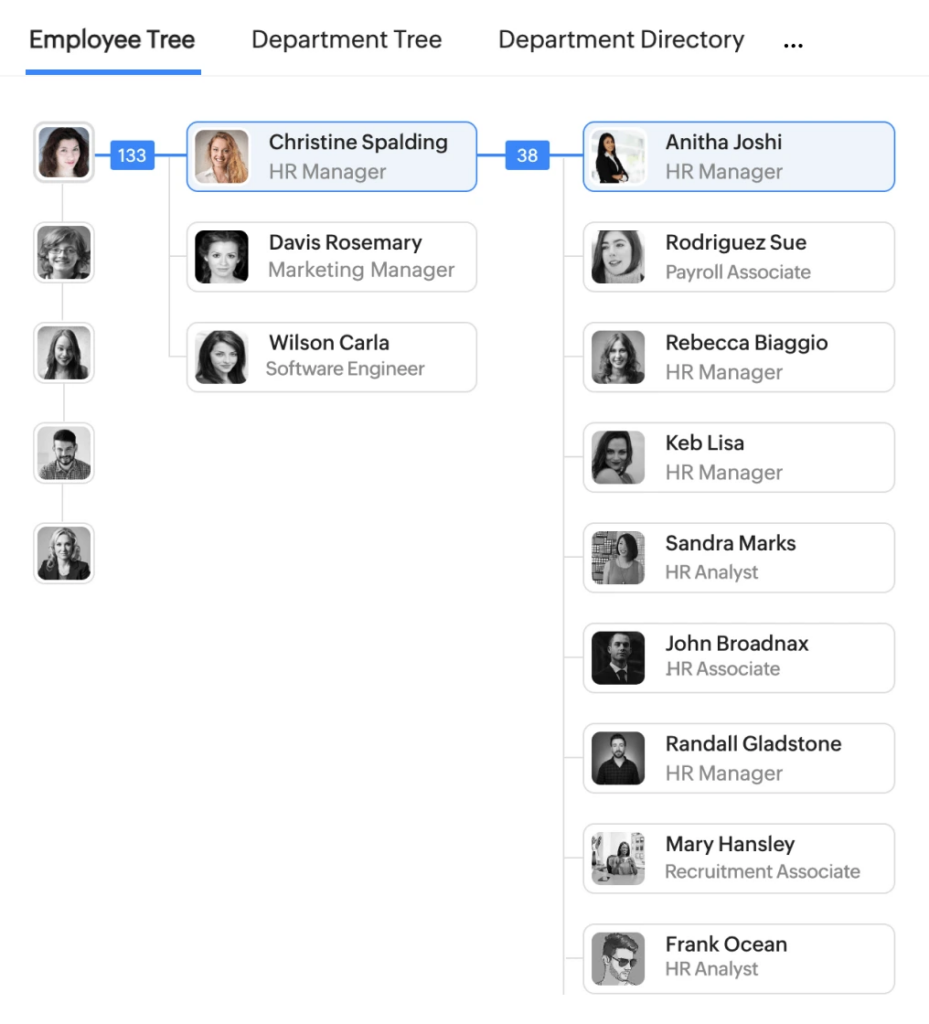
Zoho HR Suite can support the full employee journey through connected tools.
- Zoho Recruit helps manage hiring, candidate tracking, interview workflows, and recruitment pipelines.
- Zoho People helps manage employee records, onboarding, attendance, leave, documents, approvals, performance, reports, and employee self-service.
- Zoho Payroll helps manage payroll calculations, salary components, deductions, payslips, and payroll reporting.
With Zia AI and agent-based workflows, these systems can become more than digital storage. They can become an AI-assisted HR operating system.
That means HR teams can:
- Screen candidates faster
- Reduce manual hiring work
- Improve payroll review
- Track employee signals earlier
- Support fairer performance decisions
- Answer HR questions faster
- Build better workforce reports
- Improve manager visibility
For Egyptian companies, this is especially important because HR teams often carry a heavy manual workload between recruitment, attendance, leave, payroll, and reporting.
Zoho HR gives the structure. Zia AI adds the assistant layer. PyramidBITS helps implement the full workflow around how the company actually operates.
Why PyramidBITS for AI-Powered Zoho HR Implementation?
AI-powered HR is not just a software feature. It is an implementation project.
PyramidBITS helps Egyptian and MENA businesses implement Zoho HR systems around real workflows, from recruitment to payroll.
This includes:
- Reviewing the current HR process
- Mapping recruitment workflows
- Structuring employee data
- Setting up Zoho Recruit
- Configuring Zoho People
- Planning Zoho Payroll workflows
- Connecting attendance, leave, and payroll
- Setting approval cycles
- Preparing dashboards and reports
- Training HR teams and managers
- Exploring AI-assisted workflows with Zia and agents
The goal is not to replace HR people, it is to help HR teams work faster, reduce errors, and make better decisions with the right system behind them.
For companies that want to move beyond Excel and manual HR admin, Zoho HR with Zia AI can become a practical next step.
FAQs About AI in HR and Zia AI
What is AI in HR?
AI in HR means using artificial intelligence to support HR tasks such as CV screening, candidate matching, payroll review, employee feedback analysis, performance insights, reporting, and employee support.
Can AI replace HR teams?
No. AI should support HR teams, not replace them. HR decisions involve people, context, judgment, culture, and responsibility. AI can help process information faster, but humans should remain in control of sensitive decisions.
How does Zia AI help recruitment?
Zia AI in Zoho Recruit can help match candidates with job openings, generate candidate fit indicators, and help recruiters identify stronger profiles faster.
What is Payroll Guard?
Payroll Guard is a practical AI-assisted workflow concept where payroll data is reviewed before final approval to flag unusual changes, missing inputs, or possible errors. It should support payroll review, not replace HR or finance approval.
Can AI help reduce bias in HR?
AI can help identify patterns that may indicate inconsistent decisions or possible bias. However, AI must be used carefully because it can also reflect bias from poor data or poor rules. The best approach is human review supported by AI insights.
What are MCP agents?
MCP agents are AI agents that can interact with business systems through a standardized protocol. In a Zoho context, MCP can help agents connect with Zoho applications and business data to support more useful workflows.
Is Zoho HR suitable for Egyptian companies?
Yes. Zoho HR can support Egyptian companies that need recruitment, employee records, attendance, leave, payroll workflows, approvals, and reporting. The key is implementing it around the company’s real HR and payroll processes.
Conclusion
AI in HR is no longer a luxury. It is becoming a practical way for HR teams to reduce manual work, improve accuracy, and support better decisions.
Zia AI can help HR teams screen CVs faster, improve candidate matching, review payroll risks, analyze employee sentiment, support bias detection, and answer HR questions more efficiently. But AI should not replace HR judgment.
The strongest HR teams will use AI as an assistant: a layer that helps them see patterns, catch risks, and move faster while keeping humans in control of final decisions.
Zoho HR provides the system foundation. Zia AI adds intelligence. MCP agents create the next layer of connected workflow automation.
With the right implementation from PyramidBITS, Egyptian companies can move from manual HR administration to AI-assisted HR operations that are faster, more accurate, and more scalable.
Ready to Explore AI-Powered HR?
If your HR team is still screening CVs manually, checking payroll inputs line by line, chasing reports, and answering repeated employee questions, it may be time to explore Zoho HR with Zia AI.
PyramidBITS can help you assess your current HR workflow and show where AI can support your team without replacing human decision-making.
Book a Zoho HR demo with PyramidBITS
and see how Zia AI can support your HR team.