Introduction
Ask a leadership team what a broken marketing-sales handoff costs them, and most won’t have an answer — not because the cost isn’t real, but because it never shows up as one line item. It hides across four separate places: leads that go stale before anyone calls them, marketing spend that never gets a fair shot from sales, forecasts built on unreliable handoff data, and the slow erosion of trust between two teams that increasingly blame each other. Add it up, and the true cost of a broken handoff in a B2B CRM setup is almost always larger than either team suspects on its own.
Where the Cost Actually Hides
Lost leads from response delay
A lead that isn’t contacted quickly loses value fast. Independent research is consistent on this point: a Harvard Business Review study of web-generated sales leads found that companies contacting a lead within the first hour qualify it at dramatically higher rates than those who wait even a few hours longer.
Wasted marketing spend
Every lead marketing generates that sales never properly follows up on is spend that produced activity but no real shot at revenue — the campaign “worked” by marketing’s own metrics, but the money was still effectively wasted from a revenue standpoint.
Unreliable forecasting
A pipeline built on inconsistent handoff data produces forecasts nobody fully trusts. Korn Ferry’s Seller and Buyer Preferences Study, reported by Weflow, found that only 18.7% of sales organizations hit 75%+ forecast accuracy — and handoff-stage data quality is a major contributor to that gap.
Team friction and turnover
Marketing blames sales for slow follow-up; sales blames marketing for bad leads. Left unresolved, this doesn’t stay a quiet disagreement — it shows up as reduced cross-team cooperation, and eventually, in people leaving.
None of these four costs are hypothetical. What’s missing in most companies isn’t the cost — it’s the calculation.
What “Broken” Actually Looks Like in a B2B CRM Setup
B2B sales cycles make handoff problems worse than in simpler, faster-moving businesses. Multiple stakeholders, longer consideration periods, and higher deal values mean a mishandled handoff doesn’t just lose a quick transactional sale — it can lose a relationship that took months to build.
Common signs specific to B2B: a lead goes cold during a multi-week internal evaluation because nobody owned re-engagement; a deal moves to sales with incomplete context about which stakeholder actually holds budget authority; marketing and sales report different numbers for the same quarter because they’re measuring different stages of the same pipeline.
A Simple Way to Estimate Your Own Cost
Rather than quote a generic industry statistic that may not reflect your business, here’s a framework to run with your own numbers: take your monthly lead volume, estimate the percentage that get contacted late, duplicated, or dropped entirely during handoff (many companies find this is 15–25% once they actually check), and multiply by your average deal value.
For a company generating 100 B2B leads a month with a 20% handoff loss rate and an average deal value of EGP 150,000, that’s 20 leads a month — worth EGP 3,000,000 in pipeline — that never had a fair shot, every single month. Even if only a fraction of those would have converted, the number is large enough to justify fixing the handoff before fixing almost anything else in the revenue process.
How Egyptian B2B Companies Are Closing This Gap
This isn’t a theoretical problem in the Egyptian market — it’s an active one, and companies are moving to fix it quickly. Ahram Online reported that Egypt is now Zoho’s fastest-growing market globally, with customer growth around 57% CAGR and revenue up roughly 41% in 2024–2025 — much of it driven by companies replacing exactly this kind of disconnected, manual handoff process with a structured b2b crm system.
The regulatory push toward integrated systems (driven by e-invoicing compliance requirements) is accelerating this further, giving Egyptian companies an additional reason to fix marketing-sales alignment at the same time they modernize finance and operations.
How Zoho CRM Fixes the Structural Gap
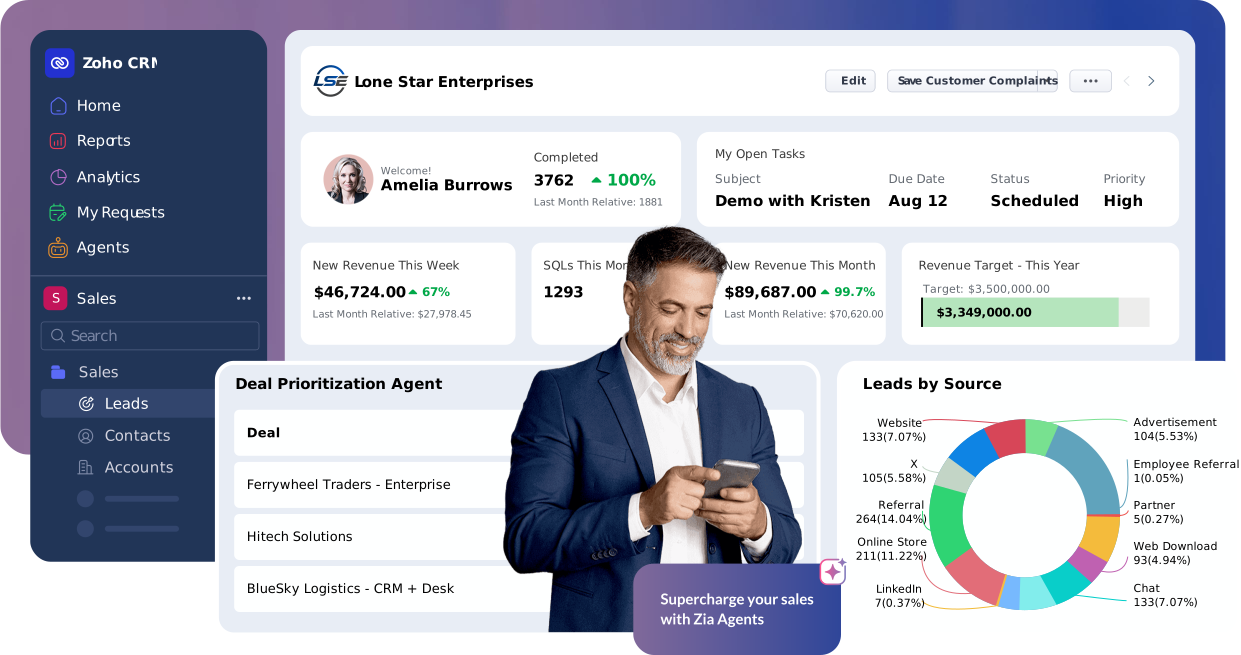
Fixing a broken handoff isn’t one feature — it’s several working together, which is exactly why this problem tends to persist until a company adopts a genuinely integrated b2b crm system rather than patching pieces individually:
Shared lead definitions and scoring mean marketing and sales stop arguing about what “qualified” means, with Zia AI applying consistent criteria instead of subjective judgment.
Instant, rule-based distribution closes the response-delay gap that costs the most in B2B specifically, where a slow first response can eliminate a company from consideration entirely.
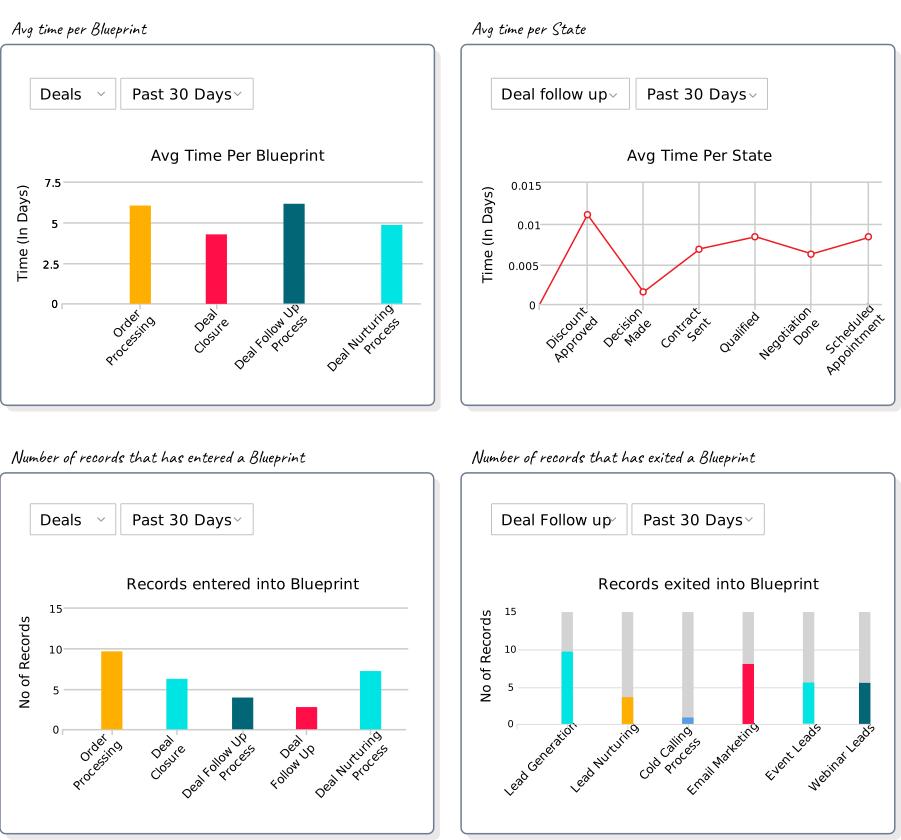
Blueprints enforce the process so handoff steps — like capturing budget authority before a deal reaches late stages — can’t quietly get skipped under deadline pressure.
Shared dashboards replace the situation where marketing and sales report different numbers for the same quarter, since both teams look at the same live data instead of separate exports.
The PyramidBITS Implementation Angle
Closing this gap requires a joint marketing-sales configuration process, not a sales-only CRM rollout that marketing is informed about after the fact. PyramidBITS’s approach includes:
- Running the handoff-cost calculation with actual client data, not the illustrative framework above, so the business case for fixing it is concrete from day one.
- Configuring shared lead scoring and distribution rules that both teams help define, covered in more depth in our guide to why B2B sales deals stall.
- Connecting marketing automation to the CRM directly, so lead source and campaign data survive the handoff instead of getting lost — our Zoho CRM marketing automation guide covers this integration.
- Building reporting both teams trust, since a shared source of truth is what actually ends the “whose numbers are right” argument — our guide to advanced analytics in Zoho CRM covers what this looks like in practice. For companies managing genuinely complex B2B cycles, our complete guide to Zoho CRM for B2B sales covers the wider configuration needed.
Practical Next Steps
Before any technology conversation, run this calculation with leadership from both teams in the room:
- Estimate your handoff loss rate honestly — pull last month’s leads and count how many were contacted late, duplicated, or simply never followed up.
- Multiply by your average deal value to get a real, defensible monthly cost figure, not an abstract concern.
- Compare marketing’s and sales’ quarterly numbers side by side. A significant mismatch is itself evidence of a broken handoff, independent of any other analysis.
- Bring both teams into the same room to review the number together — this calculation only drives change if both sides see it and agree on it, rather than one team using it as ammunition against the other.
FAQs
What does a broken marketing-sales handoff actually cost a company?
It’s rarely one number — it spans lost leads from delayed follow-up, wasted marketing spend on leads sales never properly works, unreliable forecasting built on inconsistent handoff data, and team friction that compounds over time. Estimating it requires looking at all four, not just the most visible one.
Why is this cost higher in B2B specifically?
Longer sales cycles and higher deal values mean a mishandled handoff loses more than a quick transactional sale — it can lose months of relationship-building and a much larger deal value than in faster-moving B2C contexts.
How do I calculate this cost for my own company?
Estimate your monthly lead volume, the percentage lost to late contact, duplication, or drops during handoff, and multiply by your average deal value. Most companies are surprised by how large the resulting number is once they actually run it.
Is this a technology problem or a management problem?
Both, and in that order — the underlying issue is usually a management decision (or non-decision) about shared processes, but without a b2b crm system to enforce those processes automatically, even well-intentioned agreements erode within a few months.
How long does it take to fix a broken marketing-sales handoff?
The technical configuration can be done in weeks. The harder part — getting both teams to agree on shared definitions and processes — is a management effort that has to happen in parallel, not something software alone resolves.
Book a Free Zoho CRM Demo
If you’ve never actually calculated what your handoff gap is costing, that number is worth knowing before deciding what to fix first. Book a free Zoho CRM demo with PyramidBITS and see how a properly connected b2b crm setup closes this gap end to end.