Introduction
Every forecast meeting has the same moment: a number goes up on the screen, everyone nods, and privately at least a few people in the room don’t fully believe it. Traditional sales forecasting software often just aggregates what reps type into a stage field — which means the forecast is only as honest as the most optimistic rep’s guess.
Zia, Zoho’s built-in AI, was built to replace that guess with something closer to an actual prediction, based on what’s happened in deals like this one before, not what a rep hopes will happen this time.
Why Most Sales Forecasts Are Guesses in Disguise
The scale of this problem is well documented. Research from Korn Ferry’s Seller and Buyer Preferences Study, reported by Weflow, found that only 18.7% of sales organizations achieve forecast accuracy of 75% or higher — and the most common cause cited is incomplete or unreliable CRM data, where deal stages reflect hope more than verified status.
A forecast built by summing whatever reps currently believe about their own deals isn’t really a forecast. It’s a survey of team morale. And unlike an actual survey, nobody labels it that way in the boardroom — it gets treated as a number the business can plan hiring, spending, and inventory decisions around, which is exactly why the gap between believed and actual accuracy matters so much.
What Sales Forecasting Software Actually Does
Sales forecasting software predicts expected revenue for a period — this month, this quarter — based on the deals currently in the pipeline, their stages, and historical patterns of what similar deals have actually done. Basic versions simply total open deal values.
Better sales forecasting software weights that total by the probability each deal will actually close, using either fixed stage-based percentages or, with AI involved, dynamically calculated likelihoods based on real deal behavior.
How Zia Predicts Deal Closure — 4 Signals It Actually Uses
Historical win/loss patterns.
Zia compares an open deal’s characteristics — deal size, industry, sales cycle length so far — against your team’s actual history of similar deals that won or lost, rather than applying one generic probability to every deal at a given stage.
Engagement and activity signals.
How often a prospect responds, how quickly, and through which channel all feed into Zia’s prediction — a deal that’s gone quiet for three weeks scores differently than one with active back-and-forth, even if both are technically “in the same stage.”
Deal velocity compared to your team’s norm.
Zia tracks how long deals like this one usually take to close, and flags when a specific deal is moving unusually slowly or quickly relative to that baseline — a signal a stage label alone never captures.
Sentiment in communication.
Zia reads tone across email exchanges tied to a deal, factoring in whether recent communication is trending positive or negative as part of the overall prediction.
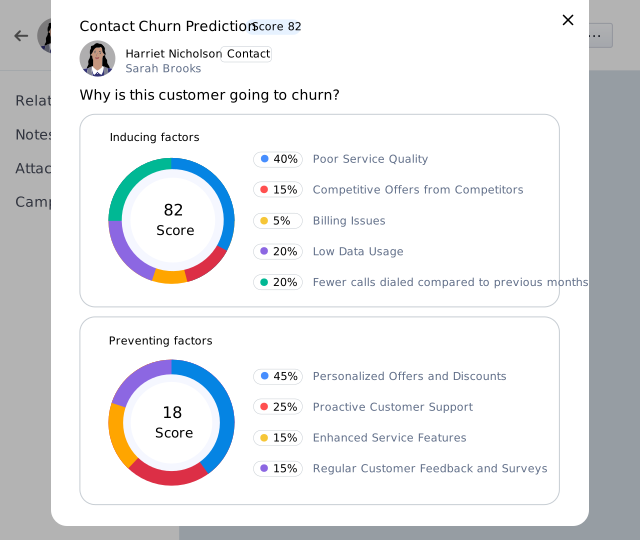
The output isn’t a single confident number. Zoho’s own documentation on its forecasting tools describes Zia’s prediction as a range — low, expected, and high — which is a more honest representation of real uncertainty than a single precise figure that implies more confidence than the data actually supports.
Forecast Accuracy: What “Good” Actually Looks Like
Given that fewer than one in five organizations hit 75%+ forecast accuracy today, that’s a more realistic benchmark to aim for than perfection. Zia’s predictions also improve over time — the model gets more accurate as more historical close data accumulates, which means forecast accuracy in month one after adopting sales forecasting software with AI prediction won’t match forecast accuracy after two or three quarters of real data. This is worth setting as an expectation early, so leadership doesn’t judge the tool on its weakest starting point.
It’s also worth knowing upfront that Zoho’s dedicated Forecast module with deal-level prediction is available on the Enterprise and Ultimate plans specifically — not the entry-level tiers — which matters when scoping a purchase decision around this capability. Companies evaluating sales forecasting software purely on price sometimes discover this gap only after committing to a lower tier, then have to upgrade mid-implementation to actually get the deal-prediction functionality they assumed was included. Confirming tier availability before budgeting avoids that scramble entirely.
The PyramidBITS Implementation Angle
Sales forecasting software only outperforms guesswork if the underlying deal data is trustworthy — a system fed messy, inconsistent stage data will simply produce confident-sounding wrong forecasts instead of honest guesses. PyramidBITS’s approach to this includes:
- Auditing historical deal data before enabling forecasting, since Zia’s predictions are only as good as the win/loss history it learns from.
- Enforcing consistent stage criteria through Blueprints, so forecast inputs mean the same thing across the whole team — the same discipline covered in our piece on why B2B sales deals stall, which often traces back to inconsistent stage tracking.
- Setting realistic accuracy expectations with leadership from day one, rather than letting an inaccurate first-month forecast undermine trust in the system before it’s had time to learn.
- Connecting forecasting to broader reporting, since forecast accuracy is one output among several — our guide to advanced analytics in Zoho CRM covers the wider reporting picture, and our dedicated guide for IT sales forecasting goes deeper for teams in that specific vertical. Our Zoho CRM implementation partner guide covers how forecasting configuration fits into a full rollout.

Practical Next Steps
Before evaluating sales forecasting software, these steps clarify what you’re actually starting from:
- Pull last quarter’s forecast versus actual results. The size and direction of the gap tells you whether the problem is optimism bias, data quality, or something else entirely.
- Check how consistently your team’s deal stages are actually used. If stage definitions vary rep to rep, no forecasting tool — AI or otherwise — can fully compensate for that.
- Confirm which Zoho CRM tier includes the Forecast module if AI-driven deal prediction specifically is the goal, since it isn’t included at every level.
- Set a realistic accuracy timeline with leadership before rollout, so early-stage predictions aren’t judged against a standard the system hasn’t had time to earn yet.
FAQs
What is sales forecasting software?
Sales forecasting software predicts expected revenue for a given period based on the deals in your pipeline, their stages, and historical closing patterns — replacing manual, gut-feel estimates with a calculated projection.
How does Zia AI predict deal closure differently from standard forecasting?
Standard forecasting typically applies a fixed probability based on deal stage alone. Zia factors in historical win/loss patterns, engagement signals, deal velocity, and communication sentiment, producing a more dynamic, deal-specific prediction rather than one generic percentage per stage.
Is Zia’s forecasting available on all Zoho CRM plans?
Zia’s core lead-scoring features are available from Professional tier up, but the dedicated Forecast module with deal-level AI prediction specifically requires Enterprise or Ultimate — worth confirming before assuming this capability is included at a lower tier.
How accurate is AI-driven sales forecasting compared to manual forecasting?
It depends heavily on data quality and how long the system has had to learn from real outcomes. AI-driven forecasting generally improves accuracy over manual, stage-only estimates, but it isn’t instantly perfect — accuracy improves as more historical close data accumulates.
Can sales forecasting software fix a team that doesn’t use consistent deal stages?
Not on its own. Forecasting software — AI-powered or not — depends on consistent, trustworthy stage data as its input. Fixing inconsistent stage usage, often through enforced Blueprint criteria, usually has to happen before forecasting accuracy can meaningfully improve.
Should a small sales team bother with AI-driven forecasting, or is it only useful at scale?
It helps at almost any size, though the value grows with pipeline volume. A team with five open deals can track them manually well enough. A team with fifty or more open deals across multiple reps loses that manual visibility fast, which is exactly where AI-driven signals — deal velocity, engagement patterns — start meaningfully outperforming a human trying to hold it all in their head.
Book a Free Zoho CRM Demo
If your last forecast meeting ended with a number nobody in the room fully trusted, that’s worth fixing before the next one — not by pushing harder for optimism, but by giving the forecast something real to stand on. Book a free Zoho CRM demo with PyramidBITS and see what Zia-driven forecasting looks like against your own deal data.