Introduction
Ask a sales manager which deals will close this quarter, and most will give you a confident answer. Ask them to show the data behind that confidence, and the answer usually gets shakier. Sales pipeline management run on gut feeling — rep optimism, “it feels close,” a stage that hasn’t actually moved in six weeks but nobody’s flagged it — isn’t really management at all. It’s a guess with a spreadsheet attached. And because that guess feeds directly into revenue planning, hiring decisions, and board reporting, the cost of getting it wrong compounds well beyond the sales team itself.
Why “Gut Feeling” Forecasting Fails
This isn’t a small, occasional problem — it’s the norm. Research from Korn Ferry’s Seller and Buyer Preferences Study, reported by Weflow, found that only 18.7% of sales organizations achieve forecast accuracy of 75% or higher. The primary reason cited: incomplete or unreliable CRM data, where reps update stages based on what they hope is happening rather than what’s actually been confirmed.
The pattern is familiar in almost every sales team: a deal sits in “negotiation” for weeks past when it realistically should have moved, but because a rep is optimistic about it, nobody questions the stage. Multiply that across a full pipeline, and the quarterly forecast becomes an aggregate of individual hopes, not a reliable prediction.
What Is Sales Pipeline Management?
Sales pipeline management is the practice of tracking every open deal through defined stages — from first contact to closed won or closed lost — with clear criteria for what has to be true before a deal can move to the next stage. Done well, it turns a pipeline into an accurate, trustworthy picture of real revenue potential. Done poorly, or manually, it turns into exactly what it looks like from the outside: a list of deals with stage labels nobody fully trusts.

4 Signs Your Pipeline Is Running on Gut Feeling
Deals sit in the same stage for weeks with no clear reason
If a deal has been “in negotiation” for a month and nobody can say specifically what’s blocking it, the stage label has stopped meaning anything.
Different reps define stages differently
One rep’s “qualified” is another rep’s “just had a first call.” Without enforced criteria, stage labels become subjective, and so does the forecast built on top of them.
Forecasts are consistently too optimistic
If your team’s forecast regularly overshoots what actually closes, that’s not bad luck — it’s a sign the pipeline reflects hope, not verified deal status.
Nobody notices a stalled deal until it’s already lost
Without automated flags, a deal that’s gone quiet just sits there until someone happens to check on it — often too late to intervene.
If two or more of these sound familiar, your sales pipeline management isn’t really running on a system — it’s running on whoever happens to remember to check in on a given week. That’s not a criticism of the team; it’s simply what happens by default without structure enforcing consistency.
How Zoho CRM Automates Pipeline Management
Zoho CRM replaces subjective, gut-feeling stage tracking with a structured system that enforces consistency automatically:
Blueprints enforce real stage criteria
Zoho CRM’s Blueprint feature lets you define exactly what must be true — a specific field filled, a task completed, a document uploaded — before a deal can move to the next stage. A rep can’t drag a deal to “negotiation” just because it feels close; the system requires the actual criteria to be met. Our complete guide to Zoho CRM Blueprints covers exactly how to design this stage-by-stage.
Zia AI flags stalled deals automatically
Instead of waiting for a manager to notice a deal has gone quiet, Zia’s anomaly detection flags deals behaving differently than similar historical deals — surfacing the problem while there’s still time to act, not after the deal is already lost.
Deal prediction replaces gut feeling with data
Zia scores the likelihood that an open deal will actually close, based on real patterns from your team’s won and lost history — giving managers an evidence-based forecast instead of an aggregate of individual optimism.
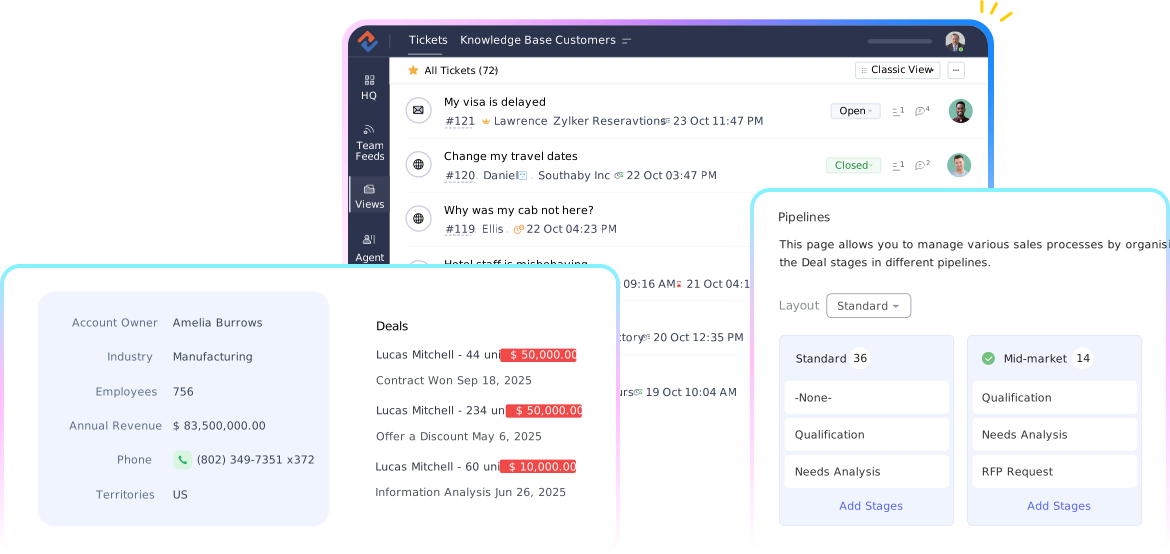
Dashboards show pipeline health in real time
Sales managers can see stage-by-stage pipeline health, average time in each stage, and forecast accuracy trends without waiting for a manual pipeline review meeting to find out something’s off. Our guide to advanced analytics in Zoho CRM covers this reporting layer in more depth.
This same structured approach is what fixes the underlying problem behind why B2B sales deals stall in the first place — a pipeline without enforced stages and automated flags will always eventually revert to gut feeling, no matter how disciplined the team starts out.
The PyramidBITS Implementation Angle
A Blueprint or dashboard configured generically doesn’t fix gut-feeling forecasting — it has to reflect your actual sales process, not a template. PyramidBITS’s approach to this includes:
- Mapping your real sales stages first, including what genuinely needs to be true before a deal can honestly move forward — not an idealized version of your process.
- Building Blueprint rules that match reality, so reps aren’t blocked by requirements that don’t fit how deals actually progress, which is what causes teams to abandon structured pipelines and revert to spreadsheets. This is the same discipline covered in our broader piece on why growing sales teams outgrow spreadsheets in the first place.
- Configuring Zia’s deal prediction around your team’s actual historical win/loss data, so scoring reflects your business, not a generic model.
- Training managers to run pipeline reviews around the dashboard data, not a verbal status update from each rep — the single biggest shift most teams need to actually stop managing on gut feeling.

Practical Next Steps
Before configuring any automation, these four checks will show you exactly how much gut feeling is currently driving your pipeline:
- Pull every deal that’s been in the same stage for 30+ days and ask each rep, specifically, what’s blocking it. Vague answers reveal where stage criteria are missing.
- Compare last quarter’s forecast to what actually closed. A consistent gap in one direction points to a systemic optimism bias, not bad luck.
- Ask three different reps to define what “qualified” means at your company. If you get three different answers, that’s your stage-definition problem in a sentence.
- Check whether anyone was notified the last time a deal went quiet for two+ weeks. If the honest answer is no, you have no stall-detection system at all.
FAQs
What is sales pipeline management?
Sales pipeline management is the process of tracking deals through defined stages — from first contact to close — with clear criteria for what has to happen before a deal can advance, giving sales leaders an accurate picture of real revenue potential.
How is automated pipeline management different from a manual spreadsheet?
A spreadsheet can list deal stages, but it can’t enforce stage criteria, flag stalled deals automatically, or predict close likelihood based on historical patterns. Automated sales pipeline management does all of this without relying on someone remembering to check.
Can Zoho CRM stop reps from skipping pipeline stages?
Yes. Zoho CRM’s Blueprint feature can require specific fields, tasks, or approvals before a deal is allowed to move to the next stage, preventing reps from advancing deals prematurely based on optimism alone.
Does sales pipeline automation replace the sales manager’s judgment?
No — it replaces guessing with data the manager can then apply judgment to. Zia’s deal scoring and stall alerts surface what needs attention; deciding how to intervene is still a human decision.
How long does it take to set up automated pipeline management in Zoho CRM?
Mapping accurate stage criteria usually takes longer than the technical Blueprint configuration itself — most teams can have a working, enforced pipeline within a few weeks once the actual stage definitions are agreed on internally.
Is sales pipeline management the same as sales forecasting?
They’re related but not identical. Sales pipeline management is the ongoing process of tracking and moving deals through defined stages. Sales forecasting is the output — a prediction of expected revenue based on that pipeline data.
Accurate forecasting depends entirely on disciplined pipeline management; a messy pipeline will always produce an unreliable forecast, no matter how sophisticated the forecasting method applied on top of it.
Book a Free Zoho CRM Demo
If your quarterly forecast is really just an aggregate of rep optimism, that’s worth fixing before the next planning cycle.
Book a free Zoho CRM demo with PyramidBITS and see what a pipeline built on enforced stages and real data looks like.