

Introduction
The deal closes. The rep updates the stage to “Closed Won,” maybe sends a congratulatory Slack message, and turns their attention to the next opportunity in the pipeline. Somewhere in that moment, the account is supposed to transfer to whoever handles the customer next — but in most companies, that sales handoff is an email, a verbal mention in a stand-up, or nothing formal at all.
The customer, meanwhile, has no idea any of this happened. They just know that the person who understood their situation is gone, and the next person is starting from zero. This gap gets almost no attention compared to the marketing-to-sales handoff earlier in the funnel, despite arguably mattering more for long-term revenue.
Why the Sales Handoff Gets Ignored
This isn’t negligence — it’s incentives working exactly as designed. Account executives are typically compensated on closed revenue, not on handoff quality, so the moment a deal closes, their attention rationally shifts to the next deal.
Nobody’s measuring how well they documented the customer’s goals, concerns, or the specific promises made during the sales cycle, so that documentation often just doesn’t happen. This is a structural gap, not a character flaw in any individual rep — fixing it requires a system that captures the handoff automatically, since relying on reps to prioritize it voluntarily works against how they’re actually incentivized.
What Breaks When the Sales Handoff Isn’t Automated
Context gets lost
Whatever the rep learned about the customer’s goals, technical requirements, and internal stakeholders either lives in their head or scattered across emails nobody else can easily search.
The customer re-explains everything
A new contact — customer success, onboarding, support — starts the relationship by asking questions the customer already answered during the sales process, which reads as the company not paying attention.
Early milestones slip
Research on this specific transition is consistent: OnRamp’s 2026 research on customer onboarding found that only 47% of teams rate their current sales-to-success handoff process as excellent, while 66% of engagement leaders say customers are far more likely to hit their first value milestone on time when the handoff is structured and documented.
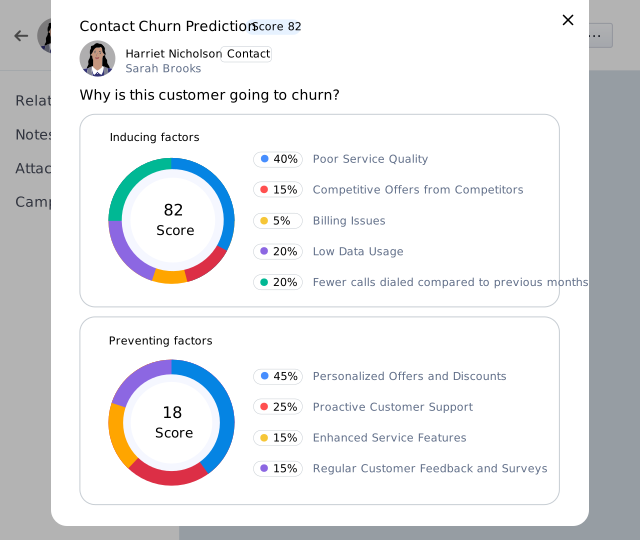
Churn risk rises quietly
Salesforce’s own analysis of customer churn lists poor onboarding and misaligned expectations — both direct consequences of a weak handoff — among the most common reasons customers leave, often without the pattern being visible until well after the relationship has already soured.
What a Real Sales Handoff Actually Requires
A structured sales handoff isn’t a longer email — it’s a documented transfer of four specific things: the customer’s stated goals and success criteria, any technical or integration requirements discussed during the sale, the specific promises or commitments made (including anything a rep said informally that the customer will remember), and a clear point of contact the customer is introduced to, not just told about. None of this needs to be complicated.
It needs to be consistent and it needs to happen every time, which is exactly what informal, verbal handoffs fail to guarantee. A handoff that depends on a rep’s memory and goodwill will work most of the time — and “most of the time” is precisely the failure rate that shows up later as unexplained early churn.
How Zoho Automates the Sales-to-Success Handoff
Blueprint-triggered handoff tasks
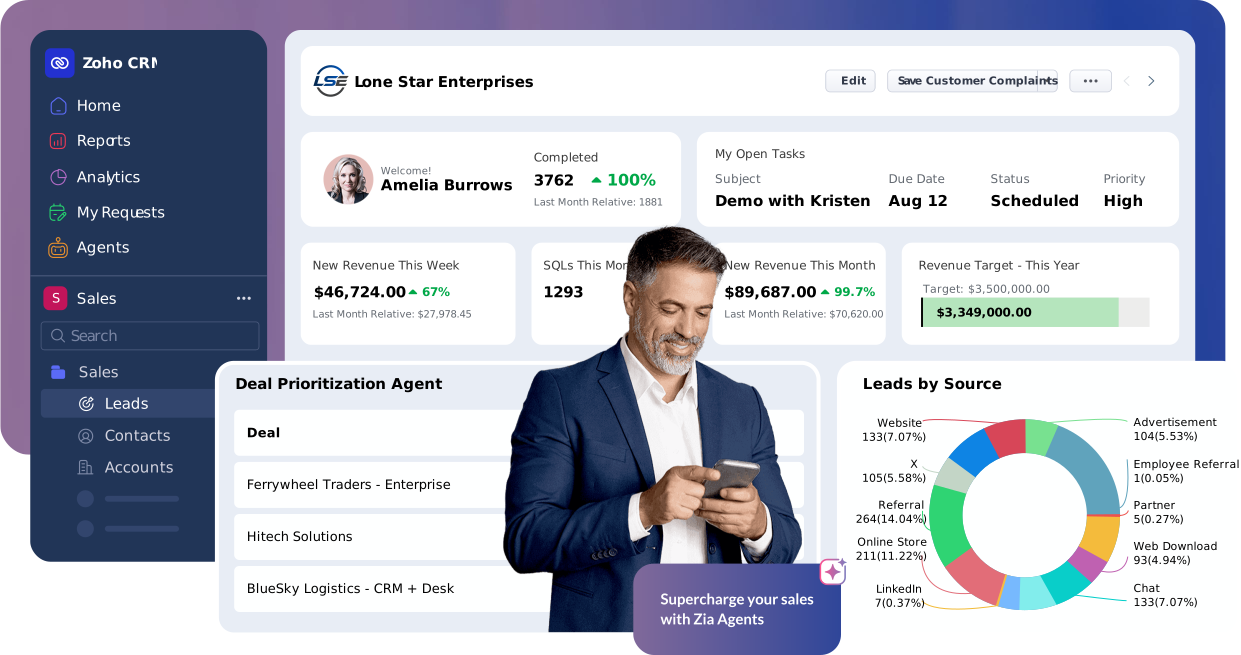
When a deal moves to Closed Won, a Blueprint transition can automatically require handoff fields to be completed — goals, key stakeholders, commitments made — before the deal is allowed to fully close, turning the handoff into an enforced step rather than an optional courtesy. Our complete guide to Zoho CRM Blueprints covers how this enforcement mechanism works in more depth.
Automatic record creation in Zoho Desk
Rather than a customer success or support contact starting from a blank record, Zoho CRM’s integration with Zoho Desk can automatically create a linked customer record carrying over the full sales history — no manual re-entry, no information stuck in a system the next team can’t access.
One shared customer record, not a rebuild
The account’s full history — every call, email, and note from the sales cycle — stays attached and visible to whoever owns the account next, which is the same principle behind Zoho CRM’s approach to the customer journey from first click through post-sale.
Renewal and check-in reminders set automatically
The handoff isn’t a one-time event — automated reminders for early check-ins and renewal timelines get scheduled the moment the deal closes, rather than depending on someone remembering weeks or months later.
The PyramidBITS Implementation Angle
A handoff process only works if it’s actually built into the system both teams use — a policy document nobody enforces gets ignored the same way an informal verbal handoff does. PyramidBITS’s approach includes:
- Defining what information actually needs to transfer, specific to your sales cycle and product, rather than a generic handoff template.
- Building the Blueprint enforcement so handoff fields are required, not optional, at the Closed Won stage — the same discipline behind why B2B deals stall when internal handoffs earlier in the cycle aren’t enforced either.
- Connecting Zoho CRM and Zoho Desk (or your support/success tool) so the transfer happens automatically, not through a manual export.
- Training both sales and customer success together on the new process, since a handoff only one side takes seriously doesn’t actually close the gap.
[Insert Image 4 — alt text: “sales and customer success teams reviewing zoho crm handoff”]
Practical Next Steps
Before building any automation, these steps clarify how big your current handoff gap actually is:
- Ask your last five new customers what their first interaction with customer success felt like. If “I had to explain everything again” comes up, that’s your handoff gap in their own words.
- Check whether handoff documentation exists anywhere consistent — a CRM field, a shared doc — or whether it depends entirely on what an individual rep chooses to write down.
- Look at your early churn or at-risk accounts from the last two quarters and see how many trace back to a rocky first 90 days rather than a product issue.
- Identify who currently owns the handoff process. If the honest answer is “nobody specifically,” that’s the first thing to fix before any tooling conversation.
FAQs
What is a sales handoff?
A sales handoff is the transfer of a customer account from the sales team to whoever manages the relationship next — customer success, onboarding, or support — including the context, commitments, and goals established during the sales process.
Why does the sales handoff matter for churn specifically?
A weak handoff means the new team starts without full context, which slows time-to-value and creates a rocky first impression. Research consistently links early onboarding quality to long-term retention, making the handoff one of the highest-leverage moments in the customer relationship.
How can Zoho CRM automate the sales-to-customer-success handoff?
Through Blueprint-enforced handoff fields at the Closed Won stage, automatic record creation in Zoho Desk carrying over full sales history, and scheduled check-in or renewal reminders — removing dependence on any individual rep remembering to do it manually.
Is this only relevant for SaaS or subscription businesses?
No — any business where a customer relationship continues after the initial sale (implementation projects, ongoing service contracts, repeat B2B purchasing) benefits from a structured handoff, not just subscription software companies. The specific documents and fields may differ, but the underlying principle — don’t let context disappear when ownership changes hands — applies just as much to a one-time implementation project as it does to an annual subscription.
Who should own the sales handoff process — sales or customer success?
Neither team alone. The handoff works best as a jointly defined process with clear ownership at each step, enforced by the system rather than depending on either team’s individual discipline.
What’s the difference between a sales handoff and a customer onboarding process?
The sales handoff is the internal transfer of information and ownership from sales to whoever manages the account next. Onboarding is the customer-facing process that follows — getting them set up and to first value. A weak handoff makes onboarding harder from the very first step, since the team running onboarding is missing context they need.
Book a Free Zoho CRM Demo
If your customers are re-explaining themselves every time they talk to someone new at your company, that’s a sales handoff problem worth fixing — and it’s usually cheaper to fix than the churn it’s currently causing quietly.
Book a free Zoho CRM demo with PyramidBITS and see how the transfer from sales to customer success can happen automatically instead of informally.